By WU VUIDE
KOTA KINABALU: The State Government has allocated RM358.4 million for the sentuhan kasih rakyat (Syukur) financial aid programme, aimed at assisting the poor, by providing RM300 per month for a year.
The initiative is expected to benefit 100,000 recipients across Sabah, with payments for the first phase having commenced on February 17, 2025.
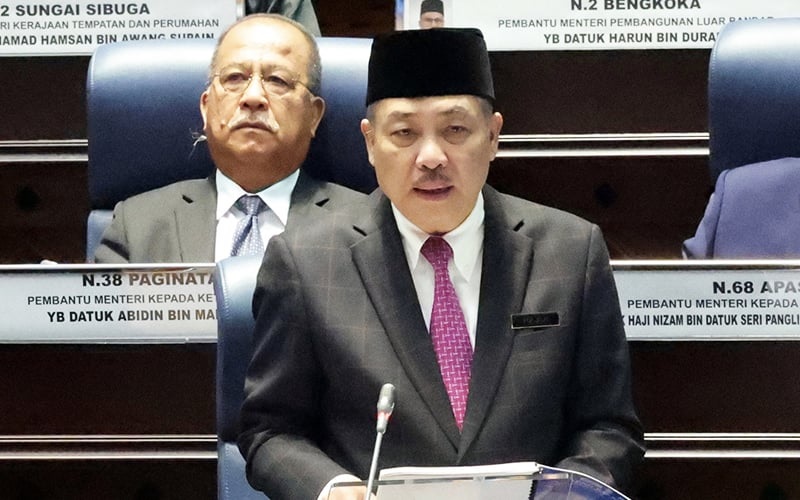
The programme distributes payments in four phases: January–March (Phase 1), April–June (Phase 2), July–September (Phase 3), and October–December (Phase 4), with each phase involving a lump-sum payment of RM900 covering three months, said Chief Minister Datuk Seri Hajiji Noor during the question-and-answer session at the State Legislative Assembly sitting here yesterday.
He was responding to a query from Kapayan Assemblywoman Jannie Lasimbang, who had asked about the number of recipients who received payments under the first phase of the Syukur 2025 programme by district in Sabah.
She also enquired about other initiatives in place to assist the poor who have been excluded from the e-Kasih list, so that they too may receive similar assistance.
For the first phase, Hajiji said it involved 72,060 heads of household (HoH) categorised as poor in the e-Kasih database as of December 2024.
“As of April 1, 2025, 13 payment batches have been processed, with 68,238 recipients having received payments, representing 95 per cent of the total beneficiaries.
“The remaining five per cent (3,822 recipients) are currently in the process of having their data updated by MySMJ officers on the ground,” he said.
To ensure that individuals excluded from the e-Kasih list are not left behind, the government has developed the Sabah state data system (Padans), allowing eligible applicants to apply online.
Additionally, he said the SMJ secretariat is working closely with the community development leader units (UPPM) and district offices to identify deserving HoHs in their respective districts.
As of March 31, 2025, the SMJ secretariat had received 270,272 applications via Padans, UPPM, district offices, and through engagement sessions with non-government assembly members for verification.
As of March 28, 2025, a total of 85 MySMJ profilers had been appointed and stationed at district offices across Sabah to coordinate applications and ensure that deserving individuals are included in the Syukur programme, he said.
According to poverty statistics from e-Kasih, as of February 28, 2025, the number of poor HoHs had seen a substantial decrease compared to February 2024.
The dynamic (non-static) data showed 1,464 poor HoHs in February 2025, down from 14,553 in February 2024, reflecting an 89.9 per cent decrease, he said.
The government remains committed to ensuring that individuals who have moved above the poverty line income (PGK) threshold are able to sustain their status.
The PGK for hardcore poor is defined as an income below RM1,218, based on an average household size of 4.3 with RM288 per capita, he said.
The government also continues to provide targeted assistance through five core areas.
In the housing sector, the government has increased the allocation of Sabah Maju Jaya Affordable Homes to 40 units per each of the 73 state constituencies, with 3,000 homes set to be built in 2025.
Since the programme began in 2022, 3,875 units have been completed as of March 28, 2025.
In the education sector, the government is enhancing existing programmes and introducing new ones aimed at eradicating poverty through human capital development.
Initiatives under the Office of the Deputy State Secretary (Special Tasks) include the Sabah education excellence awards (Aksa), Sabah PIBG activity aid (Bagus), computer assistance (Baik), special exam cash aid (Bakti), minor school maintenance assistance (Balkis), special education programme aid (Bantu), and Sabah school assistance (Bisbah).
Other initiatives include the state education savings aid (Bistari), One-Off IPT registration cash aid (Budi), graduate flight ticket subsidy for Sabahans (GRS-subfly), student association support via the Sabah Students Secretariat Malaysia (Semesta), higher education student contributions (Sentosa), and the one-off school activity grant (Sukses).
These programmes are currently being implemented with a total allocation of RM75.5 million, benefitting more than 100,000 students in 2025, he added.
The government also aims to create more job opportunities for the poor through strategic collaboration with existing investors operating in Sabah.
One such investor is the Kibing Group (SBH Kibing Solar New Materials Sdn Bhd and SBH Kibing Silicon New Materials Sdn Bhd), which is expected to offer around 700 new jobs through the operation of its third solar glass production line at the Kota Kinabalu Industrial Park (KKIP) and a silica sand processing plant in Kudat.
Other companies, such as the Sawit Kinabalu Group and BTC Berhad Group, have also pledged to provide job opportunities to the poor and hardcore poor, he added.
The SMJ Secretariat continues to collaborate closely with the Social Security Organisation (Perkeso) to expose and connect the hardcore poor with employment opportunities across various industries.
To date, 29 Aid Agencies have committed to supporting the State Government’s anti-poverty initiatives.
Recently, the Ministry of Entrepreneur Development and Cooperatives (Kuskop) launched the Ehsan@Kuskop programme, aimed at supporting poor and hardcore poor children in gaining access to quality education.
Three districts – Kota Belud, Kota Marudu, and Kudat – have been selected for a pilot project with an initial allocation of RM3 million, he said.