By JAMES LEONG
KUALA LUMPUR: The Federal Government has been urged to intensify engagement sessions with state governments to address challenges stemming from the retaliatory tariffs imposed by the United States on Malaysia.
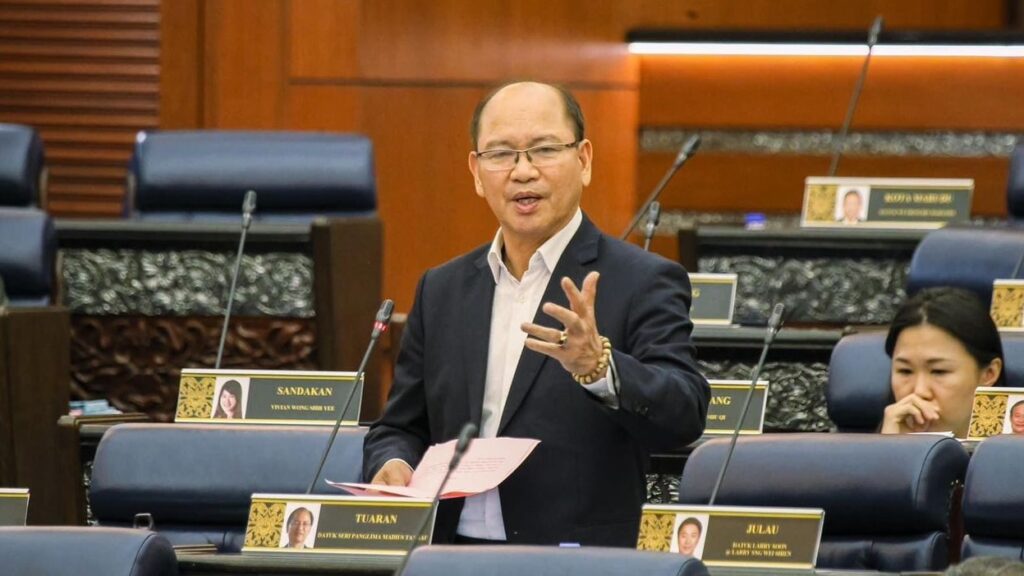
Datuk Seri Panglima Wilfred Madius Tangau (UPKO-Tuaran) emphasized the need to identify short-, medium-, and long-term challenges arising from the tariffs. He stressed that collaborative efforts would enable the government to prioritize mobilizing natural resources and human capital to maximize investment potential, particularly in downstream industries.
“For example, in Sabah, we have long advocated for advancing downstream industries in the palm oil sector, but numerous obstacles remain,” he said during his debate speech at a special parliamentary session in the Dewan Rakyat on Monday. The session was convened to discuss the tariffs announced by US President Donald Trump.
Madius highlighted that federal approval to establish a Free Trade Zone at POIC Lahad Datu requires sustained support from the central government. He called for urgent attention to resolve critical water and electricity supply issues in Sabah, which are vital for both residents and industrial growth.
“Sabah’s geopolitical position in ASEAN should be leveraged by harnessing its natural resources and strategic assets, such as the POIC Industrial Park, SOGIP Industrial Park, and Kota Kinabalu Industrial Park,” he added.
To address the tariffs, Madius proposed forming a federal-state joint task force under the Prime Minister’s Department and the Sabah Chief Minister’s Department to coordinate a multi-phase response.
Madius, who is also Honorary President of the United Progressive Kinabalu Organisation (UPKO), noted that the economic repercussions of the tariffs—announced on April 2, 2025, and effective July 1, 2025—are already being felt.
Stock market declines and reduced global commodity demand have driven Brent crude oil prices down by 14% (from USD 73 to USD 63 per barrel) and palm oil prices by 17% (from RM4,796 to RM 3,974 per tonne).
“Even Sabah, which exports only RM400 million worth of goods to the US, is impacted. The state’s revenue relies heavily on sales taxes from crude petroleum and palm oil. Its projected 2025 revenue of RM6.44 billion is now at risk,” he explained.
Madius commended the government for convening the special parliamentary session, stating that Malaysians await clarity on the nation’s strategy to mitigate the tariffs’ adverse effects.
“This session allows MPs to debate and shape Malaysia’s path forward,” said the former federal minister.