By MOHD IZHAM BIN HASHIM
KOTA KINABALU: Sabah recorded 226 of the 4,312 workplace injuries investigated nationwide in the first five months of 2026, according to the Department of Occupational Safety and Health (DOSH).
DOSH Director-General Hazlina Yon stressed that employers hold the absolute legal and moral responsibility for ensuring workers’ safety and health, regardless of a worker’s background or educational level.
“Sabah may have a high number of foreign workers and lack of proper education and training, which increases risk, but the law makes it clear that employers are fully responsible for their safety,” she told reporters at the DOSH Landscape Revolution 2.0 programme here recently.
In her officiating address at the event, Hazlina highlighted that employers must provide basic training, clear work procedures, and ensure workers fully understand how to carry out their duties safely before starting any task.
She warned that assigning tasks without proper training, supervision, and necessary personal protective equipment (PPE) remains strictly illegal, noting that enforcement actions have already resulted in RM409,000 in court fines across up till the month of May alone.
According to DOSH Sabah’s Investigation and Prosecution Division, workplace accidents in the state during the first five months of 2026 resulted in five fatalities, six cases of permanent disability and 172 non-permanent injuries.
The division’s findings also showed that men accounted for the overwhelming majority of victims, with 171 cases compared with 16 involving women.
By nationality, Malaysians recorded the highest number of cases at 114, followed by Indonesian workers with 63 cases and Filipino workers with eight.
Meanwhile, DOSH Sabah received 109 reports of suspected occupational illnesses during the same period, of which 44 were confirmed as work-related.
Nationally, Hazlina said the manufacturing sector recorded the highest number of workplace accidents and fatalities with 2,199 investigated cases, followed by the agriculture sector with 511 cases.
She also highlighted key provisions under the Occupational Safety and Health (Amendment) Act 2022, which empowers employees to remove themselves from dangerous work situations if they reasonably believe there is an imminent risk due to inadequate safety measures or the absence of appropriate protective equipment.
Hazlina said DOSH’s enforcement scope has also expanded beyond conventional workplace hazards to include psychosocial risks such as workplace stress and mental health, as well as emerging safety challenges arising from automation technologies and the gig economy.
The programme also served as the regional launch of the Occupational Safety and Health Master Plan 2030 (OSHMP30), a national framework aimed at strengthening workplace safety and health through long-term resilience and sustainability. The plan incorporates Industrial Revolution 4.0 technologies, including artificial intelligence (AI), the Internet of Things (IoT) and big data analytics, to improve workplace risk management.
More than 130 industry stakeholders attended the seminar, which featured presentations by 2024 National OSH Award recipient Dwiputera Bin Subagio, Terminal Manager of SBGAST; Datuk Dr Suzain Suhaimi of Jesselton Medical Centre; and representatives from DOSH Sabah and Sedafiat.
The event also showcased DOSH’s latest enforcement initiatives, including the rollout of the Integrated Industrial Chemical Management System (IICMS), a RM2.6 million web-based platform developed to improve chemical tracking and strengthen hazardous materials (HAZMAT) emergency response nationwide.
Among those who attended include DOSH Sabah Director and DOSH Sabah Welfare and Sports Organization President Haji Zulkifly Sulaiman, DOSH Sabah Deputy Director of Operations Haji Afanizam Ali, DOSH Sabah Deputy Director of Technical Services Norimah Ghani, and OSH Landscape Revolution 2.0 Seminar Program Manager Engineer Mohd Yunus Yusof.
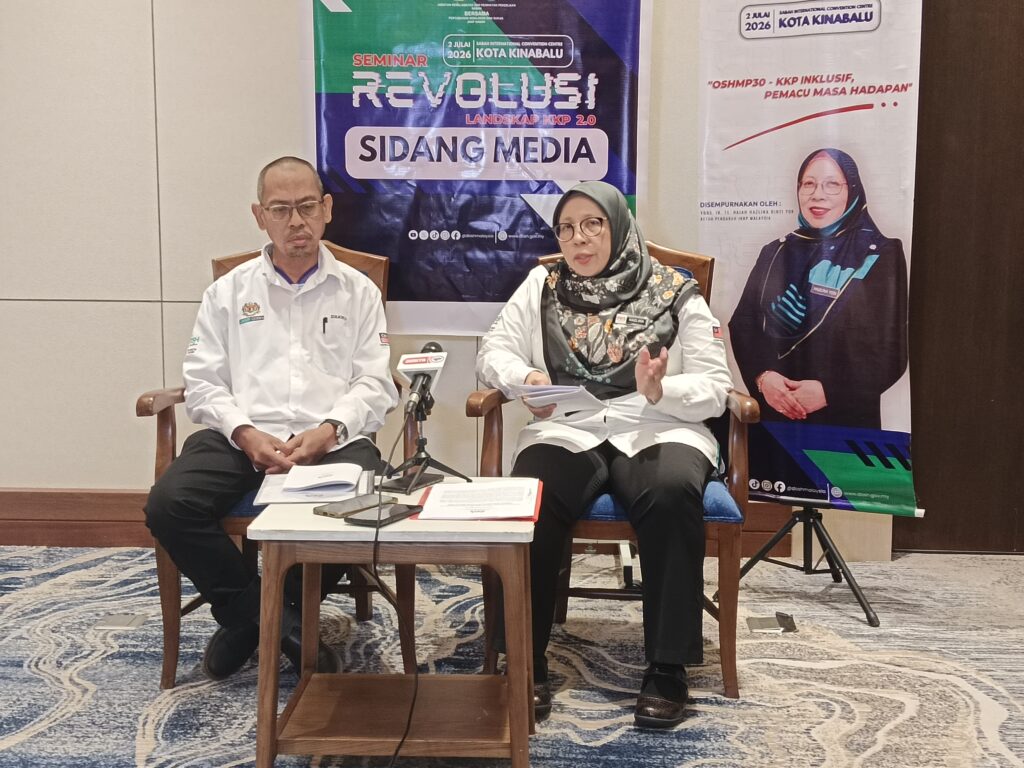
Zulkifli (left), and Hazlina (seated right), speaking to reporters at the DOSH Landscape Revolution 2.0 programme here.