SANDAKAN: Rehabilitation and community outreach programmes for former prisoners must be strengthened and sustained, with greater emphasis on providing access to employment, education and entrepreneurship opportunities to help them rebuild their lives.
Libaran Member of Parliament Datuk Suhaimi Nasir said rehabilitation efforts should go beyond outreach activities and include long-term support to help former prisoners reintegrate into society and avoid social exclusion.
He said information received indicated that at least 10 individuals were admitted to prison daily, particularly for minor offences, highlighting the need for a more comprehensive rehabilitation approach.
“After their release, some do not know where to turn and eventually see themselves as criminals, leading to further isolation from society.
“They deserve a second chance, and we hope continued efforts through programmes like this will help them improve their lives and regain their dignity,” he said.
He was speaking to reporters at the Sabah and Federal Territory of Labuan Prisons Department Outreach and Community Service Programme held at Aisyadelia Cottage, here, on Saturday.
Suhaimi said he was prepared to help connect former prisoners with education and employment opportunities, including through collaboration with government agencies.
He also urged the Kawasan Rukun Tetangga (KRT) and village heads to play a more active role in supporting former prisoners as they adjust to life outside prison.
He added that he was willing to seek government funding to support similar initiatives where necessary.
On entrepreneurship, Suhaimi said access to grants and financial assistance should be made easier, particularly for those facing documentation challenges, such as the lack of bank accounts and business registration.
He suggested that former prisoners be considered for entrepreneurship programmes, including the Tunas Usahawan Belia Bumiputera (TUBE), as well as assistance schemes offered by TEKUN Nasional, Amanah Ikhtiar Malaysia (AIM) and SME Corporation Malaysia (SME Corp).
He said the restaurant and plantation sectors could also provide employment opportunities, given their demand for workers.
Suhaimi further proposed that job placements outside former prisoners’ home districts be considered to give them a fresh environment and help them rebuild their lives without being burdened by the stigma associated with their past.
“Giving them the opportunity to work in another district would allow them to gain new experiences.
“Being in a different environment may make it easier for them to adapt and work towards a better future,” he said.
He said he would continue working with the Prisons Department of Malaysia to expand rehabilitation initiatives and opportunities beyond Sandakan to other parts of Sabah.
Citing information received, Suhaimi said more than 5,000 Malaysians in Sabah were facing similar circumstances, underscoring the need for a coordinated effort to ensure effective rehabilitation and reintegration into society. – James Leong
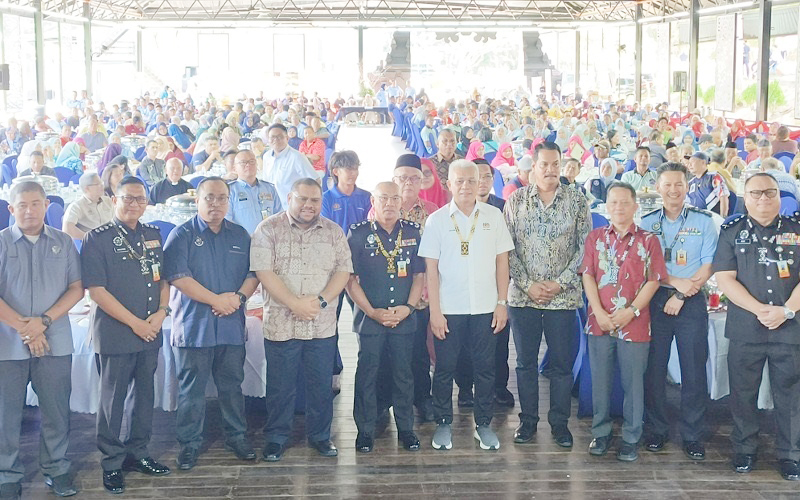
Suhaimi (5th from right), with other officials at the programme.