By WU VUIDE
KOTA KINABALU: The success of the Sabah Maju Jaya (SMJ) 2.0 Development Plan depends on the coordination of the entire civil service, said State Secretary Datuk Zainudin Aman.
He said the culture of working in isolation must be replaced with a collaborative approach, with every ministry, department and agency positioned as a strategic partner in driving the state’s and nation’s development agenda.
The synergy must also extend to the private sector, academia and the community to ensure every development initiative is implemented in a more coordinated, efficient and impactful manner, he added.
“Strategic communication must also be enhanced through transparent performance reporting, monitoring dashboards and effective data sharing to ensure every policy and initiative can be monitored, evaluated and continuously improved,” he said when officiating at the Sankalpa Sabah 2030 Programme: SMJ 2.0 Strategic Implementation Forum at the Sabah International Convention Centre (SICC).
He said the rapid technological advancement worldwide had prompted SMJ 2.0 to adopt digitalisation and AI as strategic enablers to improve administrative efficiency, boost productivity and transform public service delivery.
He said the achievement under SMJ 1.0 had proven that clear policies and effective implementation could deliver tangible benefits to the state and its people.
For SMJ 2.0, he said key performance indicators (KPIs) would be assessed based on improvements in the well-being of Sabahans.
Meanwhile, Zainudin said following his meeting with Chief Secretary to the Government Tan Sri Shamsul Azri Abu Bakar on July 6, several key matters were agreed upon to strengthen public service delivery and the implementation of Sabah’s development agenda.
Among them was the implementation of the Bureaucratic Red Tape Reform (RKB) in project management through the Review, Keep and Boost concept to expedite project processes in Sabah.
He added that a proposal to create nearly 300 posts involving 26 agencies under the implementation of the Malaysia Agreement 1963 (MA63) was also agreed upon without requiring a Self-Audit of Establishment and Organisation (AKPO).
In addition, meetings between the Federal and State Governments will be jointly chaired by the Chief Secretary to the Government and the State Secretary to discuss the implementation status and resolution of development projects.
Zainudin called on all Permanent Secretaries and Heads of Departments to prioritise the implementation of RKB by identifying at least one existing work procedure that could be improved through the approach.
He said every ministry and department should also have a strategic plan, ISO certification, an Anti-Bribery Management System (ABMS) and Good Regulatory Practice (GRP), while integrating AI technology into work processes that had undergone the RKB phase to maximise public service delivery efficiency.
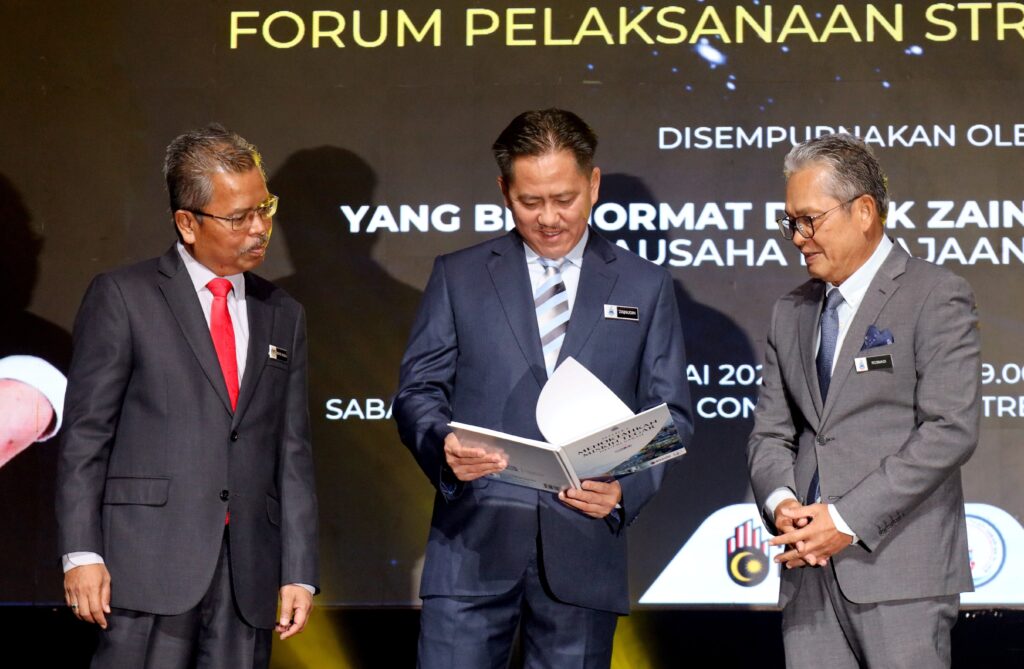
Zainudin (centre), browsing a book during the launch of the Sankalpa Sabah 2030 programme.