By WU VUIDE
KOTA KINABALU: Dryland paddy cultivation is now among the main priorities to strengthen Sabah’s food security.
Agriculture, Fisheries and Food Industry Minister Datuk Jamawi Jaafar said the approach has strong potential as an alternative to wet paddy cultivation in areas without adequate irrigation systems.
He said the ministry is planning to introduce dryland paddy cultivation on a wider scale, including planting in pots and polybags around homes.
“Once studies on suitable varieties are completed, we will launch the initiative in the near future,” he said during the Kaamatan 2026 celebration at Wisma Pertanian Sabah.
Jamawi said the initiative forms part of efforts to strengthen the kitchen garden initiative, which has begun showing positive results among rural communities.
“Over the past three to four months, following the promotion of kitchen gardens, there are already farmers and villagers trying to grow dryland paddy around their homes,” he said.
He said the Agriculture Department had earlier conducted studies on several paddy varieties suitable for cultivation without requiring large amounts of water.
The findings, he said, would be used to expand implementation of the cultivation throughout the state.
Jamawi said that the effort was important as Sabah still depends heavily on rice imports, which account for about 80 per cent of supply.
“When global crises occur, such as conflicts or rising transportation costs, food supplies can be affected. Therefore, we need to prepare from now,” he said.
He said dryland paddy cultivation was also suitable for Category K3 areas, which depend entirely on rainwater.
“These K3 areas do not have complete irrigation systems, so dryland paddy cultivation is among the best solutions that can be utilised,” he said.
Meanwhile, Jamawi said the ministry had instructed all related agencies to intensify efforts to identify new approaches to ensure sufficient food supply for the state.
He said apart from paddy, the government was also focusing on the production of animal feed such as corn to reduce dependence on imports.
However, he stressed that the development of dryland paddy cultivation would remain among the ministry’s priorities due to its strong potential and suitability for small-scale implementation by the people.
“This is among the initiatives that we will continue to strengthen from time to time to ensure the state’s food security remains safeguarded,” he said.
Jamawi also expressed appreciation to all parties involved in making this year’s Kaamatan celebration a success.
Several competitions were also held, including sugandoi, traditional food, best-decorated stall and ‘basaan togingo’ (best attire) competitions for men and women.
Also present were Assistant Minister Datuk Ruslan Muharam; Sabah Rubber Industry Board (LGIS) chairman Datuk Seri Jahid Jahim; the ministry’s deputy permanent secretaries Awang Dzulkernain Awang Hassan and Maria David Edick.
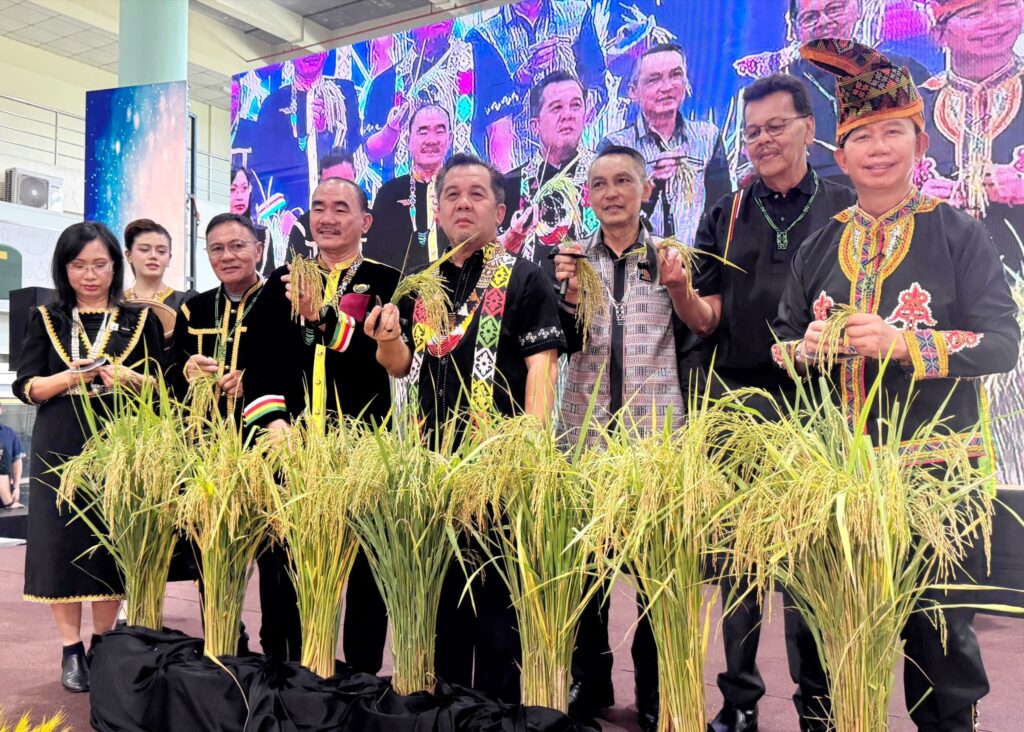
Jamawi (fourth right), performs the symbolic ‘mongomot’ paddy-cutting ceremony to officiate the Kaamatan 2026 celebration.