By WU VUIDE
KOTA KINABALU: Efforts to promote Sabah under Visit Malaysia 2026 received a boost as the state is expected to reach millions of Chinese listeners and viewers through Jiangmen Radio and Television.
Deputy Plantation and Commodities Minister Datuk Chan Foong Hin extended an invitation to people from Jiangmen and across China to visit Malaysia.
He made the call when officiating the 52nd anniversary of Malaysia–China diplomatic relations, the Chinese New Year celebration, and the Chinese Martial Arts Overseas Communication Friendship Showcase, featuring a delegation from Jiangmen City, Guangdong Province, at Kian Kok Middle School.
Since the establishment of diplomatic ties in 1974, Chan said Malaysia was the first ASEAN country to recognise the People’s Republic of China.
For 15 consecutive years, China has remained Malaysia’s largest trading partner, he added.
“Our cooperation spans manufacturing, electronics, agriculture, infrastructure, industrial parks, renewable energy, the digital economy, and high technology.
“Under the Belt and Road framework, people-to-people exchanges play a crucial role,” he said.
Deputy Consul-General of China in Kota Kinabalu Xue Xiaoning said Guangdong has long been a cradle of martial arts, with southern styles and generations of masters upholding the spirit of righteousness and courage.
The Choy Li Fut martial art, a national intangible cultural heritage widely practised in Jiangmen, integrates the strengths of southern fists and northern kicks, characterised by expansive movements and powerful momentum, she said.
It is one of the most widely practised and visually striking martial arts styles in China, she added.
“This overseas martial arts promotion programme includes hands-on cultural workshops led personally by two intangible cultural heritage inheritors from Jiangmen, with more than 40 participants,” Xue said.
The core philosophy of Chinese martial arts is “using martial virtue to stop violence”, promoting peace, justice and inclusiveness — values that strongly resonate with Malaysia’s multicultural harmony, she said.
“Through martial arts exchanges, we are not merely showcasing techniques, but building bridges of friendship, enhancing mutual understanding, and strengthening people-to-people ties,” she added.
The Consulate-General will continue to serve as a bridge, supporting diverse cultural exchanges between Sabah and China, particularly by encouraging youth engagement, she said.
Malaysia–China Friendship Association Sabah president Dr Oh Ei Sun said that over the past half-century, both countries have upheld the principles of mutual respect, equality and non-interference, while continuously deepening cooperation.
“We have achieved fruitful results across many fields, including political trust, trade and commerce, cultural exchange, and educational cooperation, bringing tangible benefits and closer ties between our peoples,” he said.
In recent years, he added, cultural and economic exchanges between Malaysia and China have become increasingly vibrant — from cultural performances, academic collaborations and student exchanges to business partnerships, investments and trade cooperation.
“All these efforts have strengthened the bridge of understanding and friendship between our two nations, bringing our hearts closer together and our cooperation to greater heights,” he said.
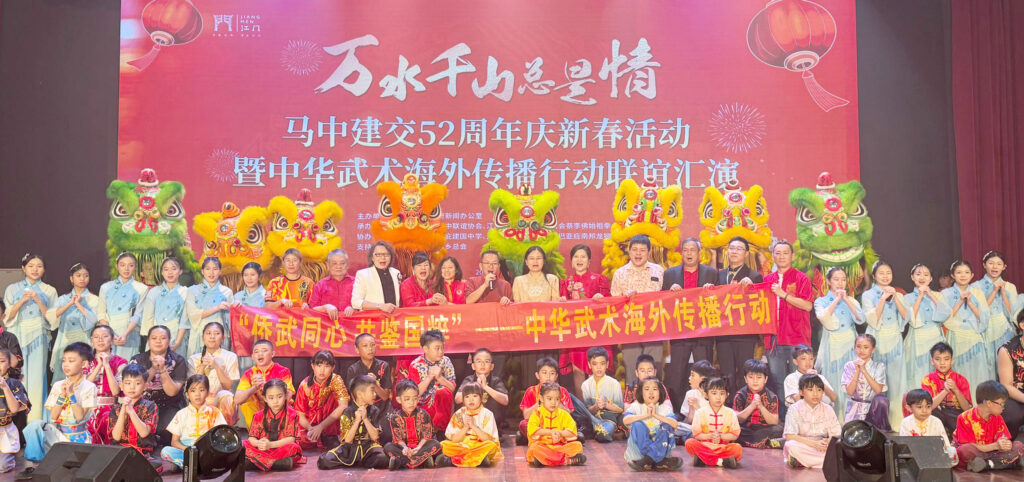
Chan, Xue and Dr Oh with guests and performers celebrating at the end of the Malaysia–China diplomatic relations event.