KOTA KINABALU: Meraki Daat Initiative is proud to announce the completion of Malaysia’s first pedestrian pathway constructed using upcycled ocean debris and island-waste plastics. The 130-meter walkway, located at Kg Lobong, Pulau Gaya, marks the successful conclusion of a pilot project launched under the UNDP Malaysia Island Waste Innovation Challenge.
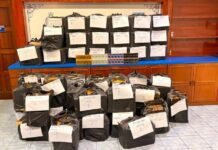
Completed on October 30, 2025, the project successfully diverted 813kg of plastic waste—equivalent to tens of thousands of bottles—preventing it from entering the ocean or being burned.
From pollution to pavement: The pathway connects the village timber bridge to the local sports court, providing a safe 3-foot-wide walkway for residents. Unlike industrial plastic roads on the mainland, this project was executed entirely “on-site” effectively closing the loop on island waste.
“This was a logistical feat that required us to reinvent how we handle waste in remote areas,” said Michelle de la Harpe, RTCA, Charter President and Project Director. “We proved that with the right expertise, passion and dedication, we can turn a logistical burden into a community asset.”
A multi-pronged cleanup effort, the materials for the pathway were sourced through three aggressive collection channels:
(1) Ocean interception: In collaboration with the Marine Research Foundation (MRF), the team utilized the “Mobula” vessel to harvest floating debris from the waters around Pulau Gaya and Sepanggar.
(2) Community collection: Local villagers and households contributed directly, incentivized to segregate PET bottles.
(3) Beach cleanups: A surge of material was collected during the ‘Cabaran Kampungku Bersih’ (My Clean Village Challenge), where residents cleaned the coastline daily from August to September.
The project, launched in January 2025, proved innovation in adversity when faced significant infrastructure hurdles, including the lack of 3-phase electricity on the island, approvals and logistical delays. The technical team, led by Project Manager Ar. Adora Shariman, adapted by developing a hybrid construction method.
“Due to mould limitations and time constraints, we innovated a system of alternating eco-pavers with concrete slabs,” said Ar. Adora. “We utilized rainwater harvesting for the concrete mix and local beach sand, keeping our carbon footprint as low as possible.”
The initiative saw expert-led execution as it was driven by a diverse team of experts ensuring quality and compliance, including Jenny Sualih, Fikry Rakawi, and Peter Yang (a background in engineering, construction, SIRIM standards, and ISO consultation), Environmentalist Iskandar Ali, and administrative team Marsyitah Marzuki and Daniel Wong.
The completion of this pilot marks the beginning of a larger vision. With the pilot complete, the team is currently conducting final stress tests and certification processes to commercialize the eco-paver technology.
While plastic-modified asphalt roads have recently been tested in Peninsular Malaysia and Sarawak using industrial waste, the Meraki Daat Initiative’s project stands apart. This is Malaysia’s first infrastructure project designed specifically for the logistical realities of island communities and the first to rely entirely on upcycled marine debris rather than factory scraps.
“We are not just building roads; we are solving the ‘island waste trap’,” said Michelle de la Harpe, President of the Meraki Daat Initiative. “Unlike mainland projects that have easy access to heavy machinery and raw materials, our solution is engineered for remote areas, where bringing in concrete is expensive, but plastic waste is abundant.”
“Our vision is to address two of Sabah’s most persistent challenges with a single solution: the poor condition of rural roads and the escalating plastic waste crisis,” said Michelle. “We have proven that ocean waste can be engineered into durable infrastructure. Now, we are ready to scale.”
With the pilot data secured, Meraki Daat Initiative is explicitly calling on the State Government of Sabah to formalize their support. Following a successful presentation to state officials in January, the team is now moving to commercialize this technology to address the critical shortage of durable rural infrastructure in Sabah and issuing a direct call to action for the Sabah Ministry of Works and Utilities (JKR) and the Ministry of Local Government and Housing (KKTP) to formalize their support.
“We have the data, the technology, and the proof of concept,” Michelle added. “We are urging the Ministries to partner with us to adopt this eco-paver technology for rural development projects. By integrating this solution into state policy, we can simultaneously fix Sabah’s rural roads and clean our coastlines.
“We cannot do this alone,” Michelle added. “We are inviting these ministries to partner with us—not just to approve permits, but to adopt this technology for rural development projects. Together, we can turn Sabah’s plastic pollution into the roads our communities desperately need.”

Adora (left) and Michelle.