KOTA KINABALU: Efficient public transport is never just about buses, trains, or timetables. At its core, it reflects a society’s philosophy on how it values people, space, and shared resources. A well-designed public transport system provides accessible, reliable, safe, and sustainable mobility for all, while using public funds and infrastructure wisely. Its true success is measured not by profit alone, but by how well it supports economic participation, social inclusion, and environmental responsibility.
People first, not vehicles
Modern transport planning has shifted away from the old obsession with “moving traffic” towards moving people. The key question is no longer how fast vehicles can travel but how easily people can reach jobs, schools, healthcare, and daily necessities. This access-centred approach recognises that transport is as much a social service as an engineering system.
An efficient network must therefore serve everyone—including low-income households, older adults, and people with disabilities. When public transport serves only peak-hour commuters or affluent corridors, it fails its broader public mission. Research consistently shows that inclusive network design improves overall system performance and social outcomes.
Sustainability and public value
Public transport is one of the most powerful tools cities have for reducing congestion, emissions, and energy consumption. Each full bus or train removes multiple private vehicles from the road, cutting pollution and reclaiming urban space for people rather than traffic.
From this perspective, public transport should be evaluated on net socio-economic benefits, not just farebox recovery. Environmental gains, time savings, reduced accident costs, and improved public health all matter. Treating public transport as a long-term public investment aligns closely with the Sustainable Development Goals and climate commitments.
Simple networks work best
One of the most underrated principles of efficiency is simplicity. The best systems are easy to understand, even for first-time users. Clear route hierarchies—such as high-frequency trunk corridors supported by feeder services—reduce confusion, shorten travel times, and improve reliability.
Straightforward routes with consistent frequencies are also easier to operate and manage. Complexity may look impressive on a map, but it often leads to delays, missed connections, and higher operating costs. Transport authorities around the world increasingly favour legible network design for precisely these reasons.
Reliability, speed, and frequency matter most
Passengers value reliability above almost anything else. Short waiting times, predictable arrivals, and dependable transfers define a high-quality service. Competitive in-vehicle travel times—supported by bus lanes, signal priority, and efficient boarding—help public transport compete with private cars.
Efficient systems adjust frequency to demand, ensuring vehicles are neither overcrowded nor underused. Coordinated timetables and real-time information further strengthen user confidence, which is essential for retaining and growing ridership.
Integration creates seamless journeys
No single mode can do everything. Efficiency comes from integrating physical, operational, and financial elements across buses, rail, walking, cycling, and emerging on-demand services. Seamless transfers, unified ticketing systems, and harmonised information allow passengers to experience their trip as one continuous journey rather than a series of disconnected segments.
Equally important is the first- and last-mile. Safe pavements, protected crossings, feeder services, and cycle facilities expand the effective reach of public transport and make it a realistic alternative to driving. Without good access to stops and stations, even the best core network will underperform.
Equity, safety, and universal access
Efficiency without equity is incomplete. Affordable fares, adequate coverage, and thoughtful service design ensure that public transport benefits all social groups—not just those who can already afford alternatives. Fare policy, subsidies, and network planning must work together to prevent the exclusion of vulnerable users.
Safety is equally fundamental. A “safe systems” approach prioritises the protection of all users through well-lit stations, secure vehicles, clear wayfinding, and universally accessible design features such as level boarding and tactile paving. When people feel unsafe, they simply won’t use the system—no matter how fast or cheap it is.
Financial sustainability through smart management
An efficient system matches resources to demand. Running oversized vehicles on low-demand routes wastes fuel and money, while under-supply leads to overcrowding and deteriorating service. Financial sustainability depends on balancing fares, subsidies, and operating costs—without sacrificing service quality or social objectives.
Today, data plays a crucial role. Continuous monitoring of ridership, travel times, reliability, and user satisfaction enables operators to adapt services intelligently rather than blindly expanding capacity. Scenario modelling and behavioural analysis help design policies—such as fare structures or priority lanes—that encourage public transport use and reduce car dependence.
The bigger picture
Ultimately, the philosophy of efficient public transport is about choices. When public transport is reliable, affordable, safe, and easy to use, people choose it—not because they are forced to, but because it makes sense. That choice shapes cities that are more productive, more inclusive, and more liveable.
Efficiency, in this sense, is not about doing more with less at all costs. It is about doing the right things well, in service of people and the future they share.
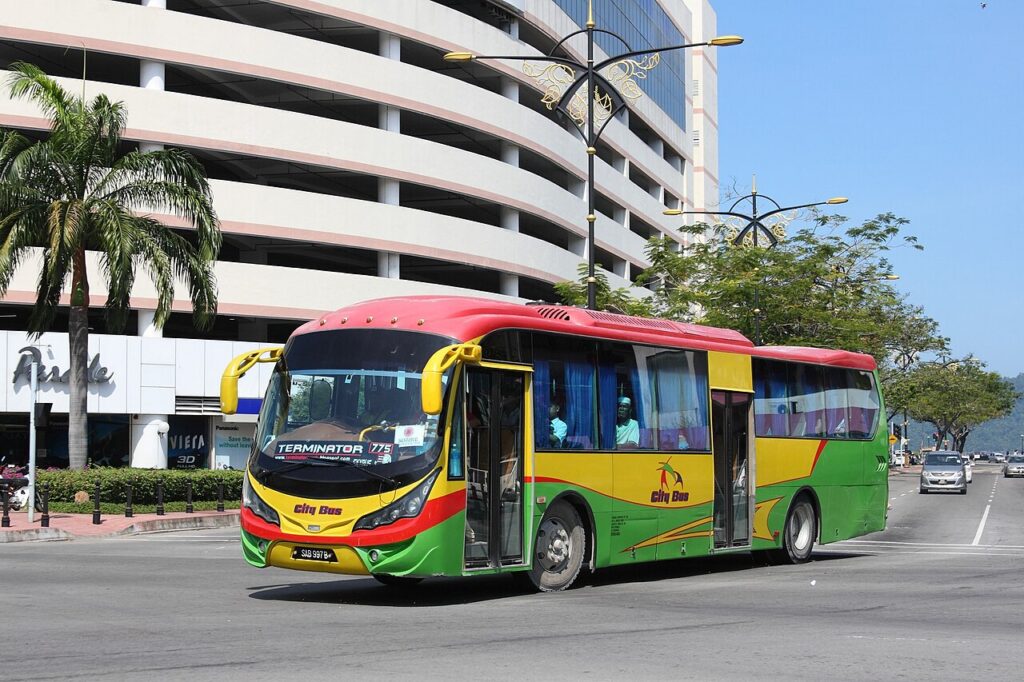
The City Bus in Kota Kinabalu. Public transport is one of the most powerful tools cities have for reducing congestion, emissions, and energy consumption.