KOTA KINABALU: Congestion at Sapangar Bay Container Port has grown from a technical hiccup into a serious threat to Sabah’s economic pulse, disrupting supply chains, driving up logistics costs, and eroding business confidence across the state.
Recognising that long-term expansion works alone cannot provide immediate relief, Datuk Ewon Benedick has steered an Interim Action Plan that combines operational, regulatory, and infrastructural measures to quickly restore flow through one of Sabah’s most critical gateways.
This essay examines each of these interim measures in depth—from the creation of a temporary container yard and stricter controls on overstaying boxes to extended agency hours, better equipment, off-site trailer staging, and full use of a Vehicle Booking System—to show how, together, they are designed to unclog Sapangar while safeguarding Sabah’s wider industrial and entrepreneurial ecosystem.
(1) Temporary container yard near Sapangar
The core idea is to open an additional temporary container yard close to Sapangar Bay Container Port to immediately expand storage and handling space while the main expansion drags on. This yard is targeted to start operations by the end of March 2026, giving a short-term capacity boost before permanent works are finished.
In practice, this yard acts as a “pressure relief valve” for the main terminal. Containers that do not need to stay inside the high-intensity terminal area (for example, longer-stay imports awaiting collection) can be shifted to the temporary yard, freeing up valuable quay-side slots for active import and export boxes. This helps reduce yard density, speeds up container retrieval, and shortens vessel turnaround times, which are critical indicators of port performance.
However, a temporary yard also brings operational challenges: it needs adequate security, IT connectivity (to integrate with the port’s system), equipment, and well-coordinated trucking between the main terminal and the yard. If the transfer of containers is poorly planned, congestion could simply move from inside the port to the roads linking the yard and terminal. The success of this measure therefore depends on strict operating procedures and real-time data on box movements.
(2) Revised storage tariffs and deterrent charges
Revising storage tariffs and introducing stronger deterrent charges is essentially a behavioural tool to discourage consignees from using the port as a long-term warehouse. When tariffs are low or enforcement is weak, many importers let containers sit for weeks or months, waiting for better cash flow, space, or market conditions. This “free or cheap storage” directly eats into yard capacity and worsens congestion.
By sharply increasing charges after a certain free-time period, the government and port operator create a financial penalty for overstaying boxes. This nudges cargo owners to clear cargo promptly, either by unstuffing containers into nearby depots or moving goods directly to warehouses. Over time, this measure reduces average dwell time (the number of days a container stays in port), which is a key driver of yard congestion.
The policy needs to be calibrated carefully. If charges rise too quickly without support measures (e.g., adequate inland depots, customs facilitation, SME assistance), small businesses may feel unfairly burdened. A balanced approach, with clear communication, some flexibility for genuine hardship cases, and consistent enforcement, is crucial to ensure the measure improves flow without unduly harming smaller players.
(3) Stricter enforcement against overstaying containers
Alongside tariff changes, enforcement is being tightened after authorities discovered 120 containers exceeding the allowed storage period, including 103 already cleared by Customs, some left more than a year at the port. This shows that congestion is not only a physical capacity problem but also a compliance and discipline issue.
Stricter enforcement can include issuing removal notices, imposing compounded penalties, or in extreme cases auctioning abandoned goods under customs law. The immediate effect is to physically clear long-staying boxes from the yard, which directly frees space and improves operational efficiency. Over time, a reputation for firm enforcement will deter consignees from treating port space as cheap or risk-free storage.
However, stronger enforcement requires robust legal processes and proper coordination between port operator, Customs, shipping lines, and consignees. Poorly managed enforcement could lead to disputes or claims, especially if notices are not properly served or records are inaccurate. Digitising records and having a transparent, published enforcement protocol helps maintain trust while achieving the intended decongestion.
(4) Extended and coordinated operating hours for all agencies
One major bottleneck identified is the mismatch between the port’s 24-hour operations and the limited office hours of supporting agencies like Customs and other government departments. The interim plan includes extending working hours, using overtime, weekends, and public holidays so that these agencies’ schedules align more closely with port operations.
This measure targets “process congestion” rather than physical congestion. A container may physically be in the yard, but if its customs or other regulatory clearances can only be processed in narrow time windows, trucks and boxes inevitably pile up waiting for paperwork. By widening the time window for inspections, approvals, and document processing, the plan smooths peaks in activity and shortens total clearance time for each container.
The challenge is manpower and cost. Extended hours require sufficient staffing and budget, and agencies must avoid spreading staff too thin, which could slow work despite longer hours. Performance metrics—such as average clearance time by agency and time-of-day analysis—will be important to ensure that longer hours translate into real efficiency gains, not just more exhausted staff.
(5) Upgrading and adding handling equipment
The interim plan also calls for upgrading and adding cargo-handling machinery and supporting equipment, such as cranes and other handling assets, to increase productivity. Even with enough yard space, ports can still be congested if cranes, reach stackers, terminal tractors, and related equipment are insufficient, outdated, or frequently breaking down.
New or upgraded equipment improves key performance metrics like crane moves per hour and truck turnaround time. Better reliability reduces unplanned downtime, and additional units create redundancy so that maintenance does not cripple operations. Over time, these investments support both the interim decongestion effort and the long-term goal of turning Sapangar into a more competitive regional hub.
However, equipment alone does not guarantee improvement; it must be paired with skilled operators, proper maintenance regimes, and a modern terminal operating system (TOS) to optimise deployment. Training, preventive maintenance, and data-driven planning are therefore essential to convert capital spending into real throughput gains.
(6) Trailer parking site at KKIP as a holding area
Using a trailer parking site at Kota Kinabalu Industrial Park (KKIP) as a holding or staging area is a traffic-management measure. The idea is to park trailers and containers outside the immediate port perimeter, especially for loads that are moved after office hours when consignees cannot receive them.
Operationally, this prevents long queues of trucks from forming within and outside the port gates, which otherwise would create gridlock, delay port entry and exit, and spill congestion onto public roads. The KKIP holding area allows transporters to time their movements more flexibly, dispatching trucks to the port or to consignees when both sides are ready.
The effectiveness of this measure hinges on good scheduling, clear rules (maximum parking time, security, fees), and safe road connectivity between KKIP and the port. Without this, the holding area could itself become congested or create safety risks. When well-managed, it becomes an important buffer that separates terminal operations from city traffic patterns, reducing stress on both.
(7) Full utilisation of the Vehicle Booking System (VBS)
Requiring transport companies to fully utilise the Vehicle Booking System (VBS) is a move to manage landside flows through digital scheduling. VBS is essentially an appointment system for trucks to enter the port within specific time slots, aligning truck arrivals with terminal capacity and ship operations.
Without VBS, many trucks tend to arrive in uneven bursts—typically during perceived “peak convenience” times—overwhelming gates and yard crews. With mandatory VBS, truck arrivals can be spread throughout the day and night, matching available crane time, gate processing capacity, and yard conditions. This reduces waiting times, cuts idle queues on access roads, and makes better use of port resources.
The success of VBS depends on strict adherence by hauliers and strong support from the port (user-friendly system, clear penalties for no-shows or unbooked arrivals, and flexibility for genuine emergencies). It also requires close communication with shipping lines and consignees so that appointment windows reflect actual cargo readiness. When properly enforced, VBS is one of the most powerful tools to manage congestion from the landside.
(8) How these measures work together
Individually, each measure addresses a specific bottleneck—yard capacity, behaviour of consignees, regulatory delays, equipment constraints, traffic flow, or truck scheduling. Together, they form a coordinated interim strategy: more space (temporary yard), faster turnover (tariffs, enforcement), smoother processes (extended hours), higher productivity (equipment), better traffic control (KKIP holding area), and smarter scheduling (VBS).
The real test will be implementation discipline: clear timelines, measurable indicators (dwell time, truck turnaround, yard utilisation, ship waiting time), and regular engagement with port users. If all elements are executed consistently, Sapangar’s congestion should ease significantly even before the full expansion is completed, restoring confidence among traders and investors in Sabah’s logistics ecosystem.
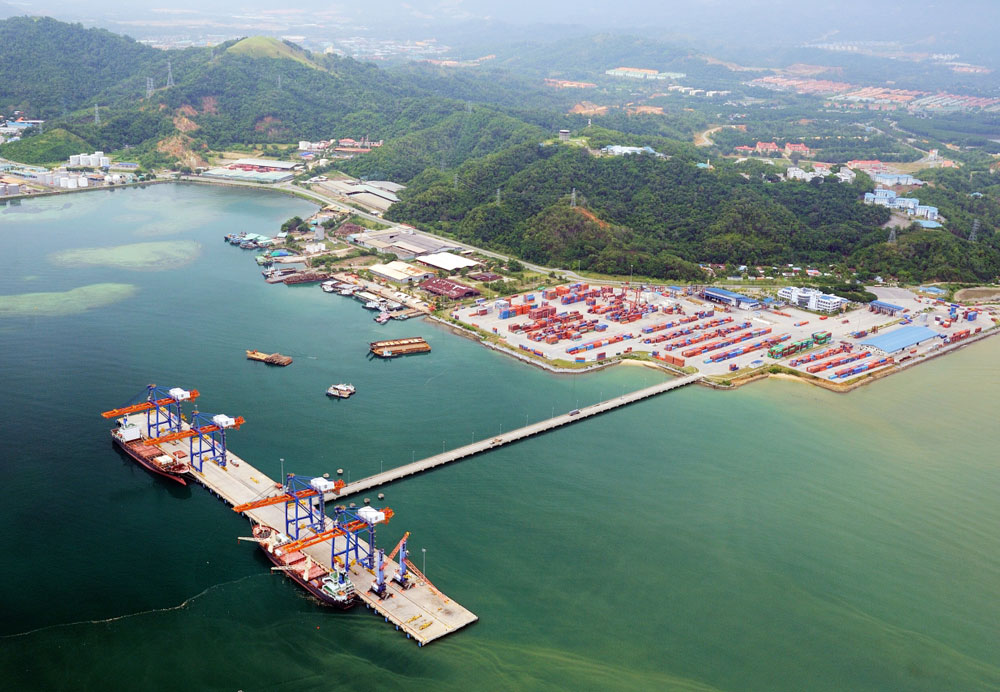
Sapangar Bay Container Port.