By JOHN TAMBANAN
KOTA KINABALU: A coalition of Sabah’s foremost trade and maritime organizations has issued a joint statement firmly supporting the proposal by Chief Minister Datuk Seri Hajiji Noor to revive barter trade, specifically along the State’s eastern maritime borders and the northern Kudat region.
The Sabah Shipping Agents Association (SSAA), Sabah Freight Forwarders and Logistics Association (SABFFLA), ASEAN-China Commerce Association (ACCA), and the Kadazandusun Chamber of Commerce and Industry (KCCI) collectively affirm that this move is a strategic necessity for regional growth, aligning seamlessly with the Sabah Maju Jaya (SMJ) 2.0 roadmap and the State’s Blue Economy strategy.
Regional Economic Drivers & CIQS Utility The Sabah Freight Forwarders and Logistics Association (SABFFLA) expressed specific support for the revival across the Sandakan, Tawau, and Lahad Datu hubs.
SABFFLA notes that while barter trade volumes differ from major containerized cargo, the trade serves as a vital income generator for logistics members and local service providers.
The association further expressed its gratitude to the chief minister for declaring the Lahad Datu CIQS for passengers, noting that the inclusion of barter trade will complement this infrastructure and maximize its utility.
Unlocking Kudat’s Potential Joining the call, ACCA President Datuk Lim Shau Hui highlighted that the cessation of barter trade between Kudat and Palawan (Southern Philippines) for many years has led to economic stagnation in the district.
Lim urged the government to expedite the implementation of this revival to restore Kudat to its former commercial glory.
He cautioned that while security is paramount, the government must ensure that “red tape” and administrative hurdles do not become stumbling blocks that prevent these plans from becoming a reality on the ground.
Chow Yang Ann, President of the SSAA and a long-standing member of the BIMP-EAGA Working Group Cluster, emphasized that traders from the Southern Philippines rely heavily on Sabah’s superior port infrastructure.
“The flow of containerized cargo between Sandakan and Zamboanga demonstrates a clear demand for efficient logistics. Formalizing and regulating barter trade will further optimize our port’s utilities,” Chow stated.
Local Economic Spin-offs Representing KCCI Trade & Investment and former lead of the BIMP-EAGA Business Council (BEBC) Sabah, Carl V Moosom highlighted the grassroots economic impact.
“Opening our ports to regulated barter trade creates vital positive spin-offs for local district economies. It is economically logical for our neighbours in the Tawi-Tawi archipelago and Palawan to source goods from Sabah’s shores rather than the more distant Philippine mainland.
”This initiative directly supports our local entrepreneurs and aligns with the government’s vision of a self-sustaining maritime economy,” he added.
The coalition believes this initiative leverages Sabah’s geographical advantage to foster a resilient economic ecosystem. By formalizing these routes and integrating them with the new CIQS facilities, the State Government is ensuring that Sabah remains the premier transshipment and trade hub within the BIMP-EAGA region.
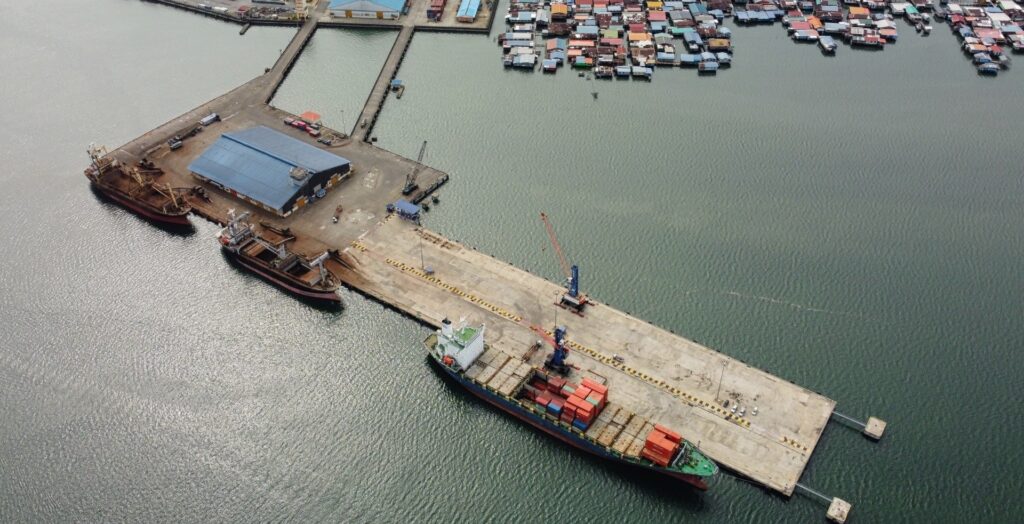
The flow of containerized cargo between Sandakan and Zamboanga demonstrates a clear demand for efficient logistics.