By WU VUIDE
KOTA KINABALU: Universiti Malaysia Sabah (UMS), in collaboration with Institute for Development Studies Sabah (IDS), has taken proactive steps to strengthen efforts to preserve ethnic mother tongues in Sabah through the implementation of the Exploratory Study Project on the Vitality and Vulnerability of Ethnic Mother Tongues in Sabah.
The initiative was translated through the organisation of the Instrument Refinement and Survey Preparation Workshop held at UMS, recently.
The workshop gathered more than 50 participants comprising researchers, students and representatives from strategic agencies, including the Sabah State Cultural Board (LKNS) and Dewan Bahasa dan Pustaka Sabah, in an effort to strengthen the research instruments before the statewide survey is carried out.
IDS chief executive officer, Professor Datuk Dr Ramzah Dambul, said the project represents an important step in preserving Sabah’s ethnic identity and cultural heritage.
“A comprehensive questionnaire instrument is a key prerequisite before researchers go into the field to ensure that every piece of data recorded is accurate and comprehensive,” he said.
The text of his officiating speech was delivered by Head of Data Management and Geographic Information System (GIS) Corrina Henry Mansa.
Meanwhile, the project’s lead researcher from the Borneo Institute for Indigenous Studies (BorIIS) at UMS, Associate Professor Dr Jane Wong Kon Ling, said the study is being conducted to obtain accurate empirical data related to the vitality and vulnerability levels of ethnic mother tongues in Sabah.
“Comprehensive data is crucial to identify languages that are still widely used, languages at risk of extinction, as well as suitable mitigation measures for documentation and revitalisation purposes.
“Without clear and comprehensive data, it is extremely difficult to determine the direction of effective language preservation, especially within Sabah’s plural society, which is rich in identity and linguistic diversity,” she said.
Jane added that Sabah’s linguistic landscape is highly complex because an individual’s ethnic identity, mother tongue, first language and daily spoken language do not necessarily reflect the same reality.
“The survey instrument developed must be context-sensitive to ensure the data collected truly reflects the actual situation of communities at the grassroots level,” she said.
At the same time, BorIIS UMS Senior Fellow, Professor Dr Jacqueline Pugh-Kitingan, stated that the process of refining the research instrument not only involves technical aspects, but also requires a deep understanding of the sociocultural context of Sabah’s ethnic communities.
BorIIS UMS Senior Lecturer, Dr Nordiana Nasuha Molinka, described the initiative as a pioneering step with the potential to pave the way for larger-scale studies related to the mapping of indigenous identity and demographics in Sabah.
According to BorIIS UMS Senior Lecturer, Dr Mohd Juhar Harun, all input obtained will be tested through a pilot study to evaluate the effectiveness of the research instrument.
The organisation of the workshop reflects the continued commitment of UMS, IDS and various relevant agencies in ensuring the sustainability of Sabah’s ethnic mother tongues as an important heritage for future generations.
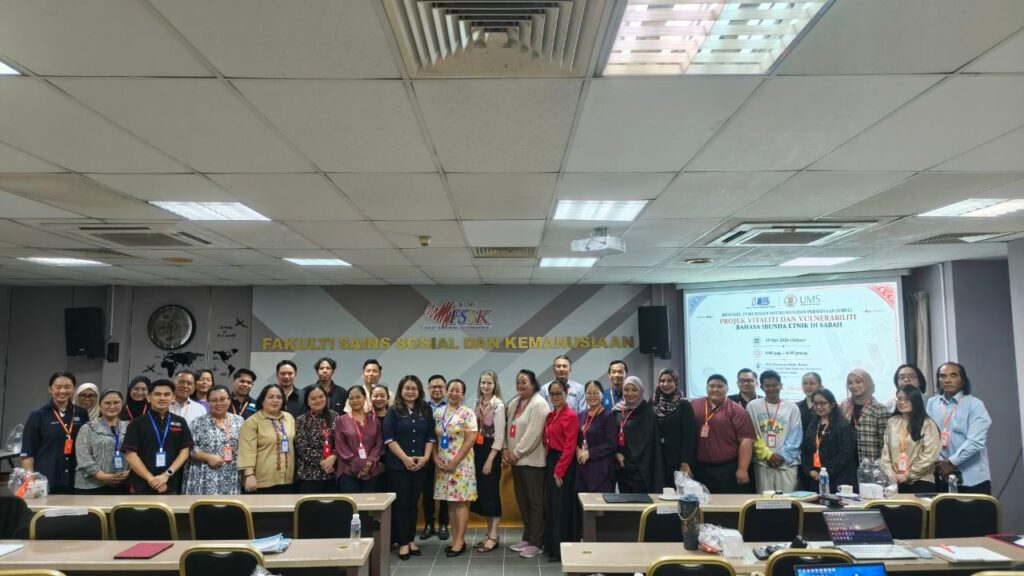
Group photo session with participants in attendance.