“Tropical fruits from ASEAN member states, including durian, mangosteen, and young coconut, are gaining increasing popularity among Chinese consumers due to their high sweetness and excellent taste. This year, our company’s import value of ASEAN fruits has exceeded 1 billion yuan, marking substantial growth,” said Li Lin, Vice President of Xinrongmao Fruit Industry Technology Group Co., Ltd., in a recent interview.
The remarks come during the 2026 “Big Market for All: Export to China” –“ASEAN Fruits Gather in Guangxi” series of events, held across various locations in the Guangxi Zhuang Autonomous Region. The events bring together fruit suppliers and traders from China and ASEAN countries for in-depth exchanges and to explore expanded cooperation opportunities. Guangxi authorities host cross-border traceability, production-supply matching and investment promotion conferences, release the Guangxi White Paper on Expanding Imports of High-Quality ASEAN Agricultural Products, and launch regular cross-border cold-chain freight trains for ASEAN fruits. These measures are aimed at accelerating the development of a cross-border fruit trade industrial and supply chain that leverages complementary strengths for mutual benefit.
The 2026 “Big Market for All: Export to China” –“ASEAN Fruits Gather in Guangxi” series of events, recently held across various locations in the Guangxi. This photo shows the scene of the project signing ceremony. (Lin Hao)
Wei Tao, Chairman of the Guangxi Zhuang Autonomous Region, states at the event that Guangxi serves as the “gateway hub” for ASEAN fruits entering the Chinese market. With the completion and opening of the Pinglu Canal in September this year, Guangxi’s strategic position as a key thoroughfare to the wider world will become even more prominent, he notes. The region is committed to working with ASEAN partners to continuously improve the cross-border trade environment, build a highly efficient platform for high-quality ASEAN agricultural products to access the Chinese market, and enable consumers to purchase a greater variety of more affordable and fresher ASEAN fruits. “We aim to make fruits a ‘sweet bond’ deepening China-ASEAN cooperation,” Wei Tao adds.
A consensus emerges during the events to expand the scale of ASEAN fruit imports into the Chinese market through Guangxi’s channels. Li Lin observes that while the influence of ASEAN fruits in the Chinese consumer market is steadily rising; tropical fruits are unlikely to be replaced by domestic production in the short term due to climatic and latitudinal factors. Consequently, the potential for China-ASEAN fruit trade remains immense.
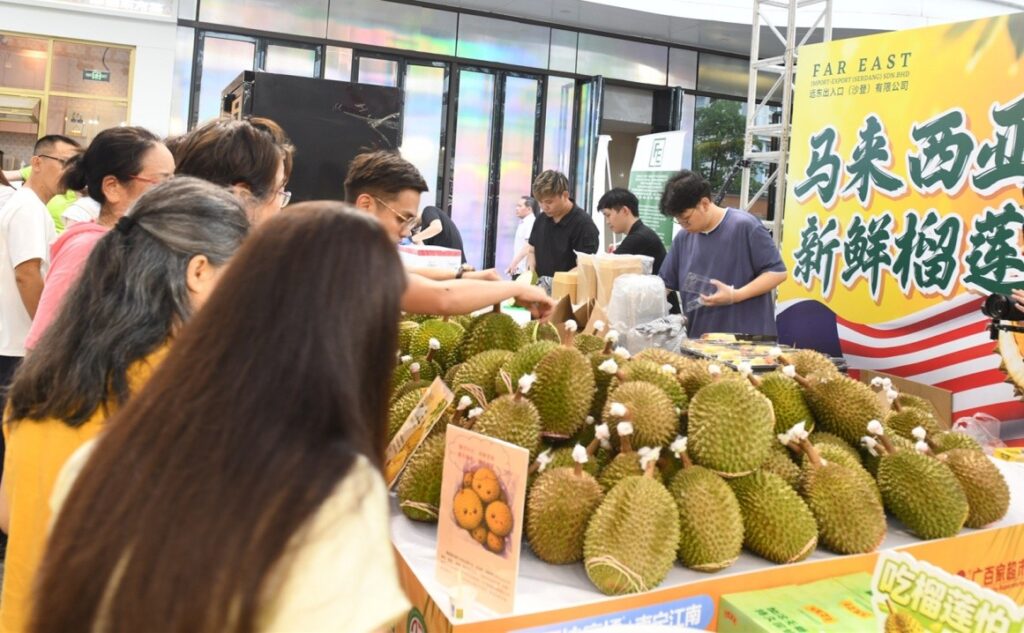
At the China-Malaysia Durian Day and the inaugural Malaysia Durian Festival (Nanning station), Leong Chee Hoe, Executive President of the Malaysia International Durian Industry Development Association, leads a delegation of durian traders featuring specialty varieties such as “Red Prawn” and “Kun Bao”. Every Musang King durian on display is harvested from Malaysian orchards and air-freighted via a full cold chain, achieving a “tree-ripe plus direct airfreight” ultra-fresh delivery model.
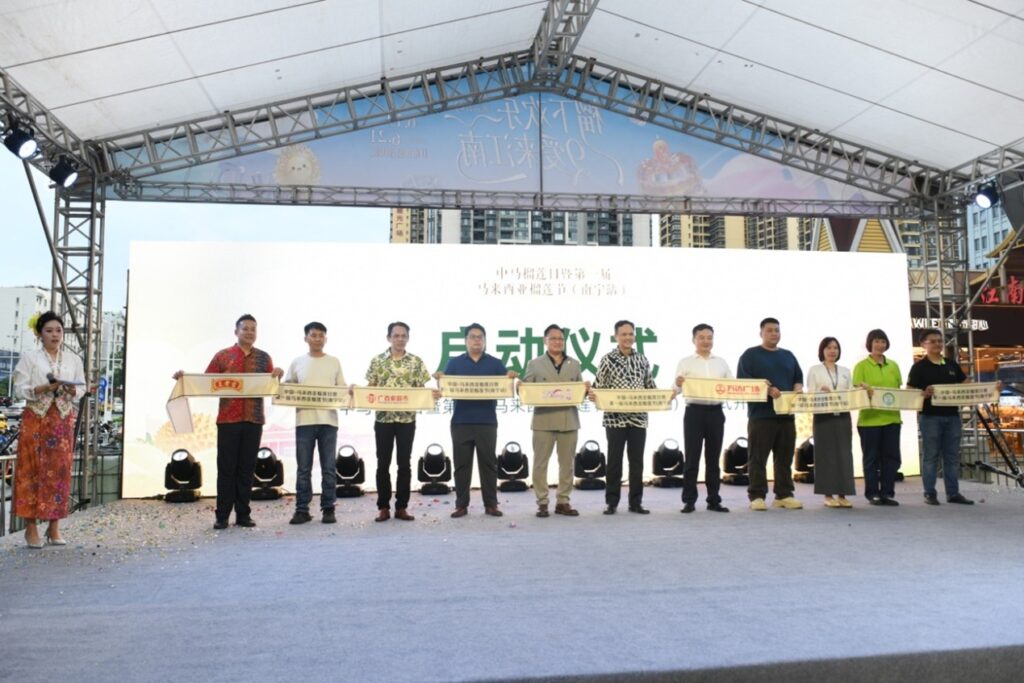
Leong Chee Hoe notes that since Malaysia’s first export of fresh durians to China in 2024, the country’s export volume of fresh durians to China has continued to rise. Simultaneously, both durian planting area and yield in Malaysia have doubled, making prices more accessible to consumers.
In the view of Ahmad Phadil bin Mohamed Ismail, Consul General of Malaysia in Nanning, China has maintained its position as the world’s largest durian consumer market in recent years, with an increasing number of ASEAN countries eager to share in the opportunities presented by this vast market. He indicates that Malaysia will continue to explore innovative ways to bring high-quality durians, such as Musang King and Black Thorn, to Chinese consumers, positioning them as the “Hermès of the durian world”.
Vietnam’s Ambassador to China, Phạm Thanh Bình, also suggestes that Vietnam and Guangxi accelerate cooperation in railway, highway, maritime transport, and logistics interconnectivity, while expediting the development of smart border ports. These efforts would further streamline distribution channels for Vietnamese and other ASEAN products into China, improve customs clearance efficiency, and promote cross-border e-commerce, thereby allowing all parties to benefit from China’s mega-market opportunities.
Liu Taige, Secretary-General of the Thailand-China Agricultural Trade Association, expresses optimism about the development potential of the fruit deep-processing industry. He notes that currently, most Thai fresh fruits, including durians, enter China via ports such as Pingxiang in Guangxi. Thai authorities are actively exploring the extension of deep-processing industrial chains in Guangxi, aiming to increase the supply of processed ASEAN fruit products, including juices and pastries, to the Chinese market.
“The Chinese consumer market is vast, and we look forward to greater cooperation with China in coconut deep-processing,” said Pakorn Chantayasakorn, President of icoco(Thailand) Co., Ltd.
Wei Tao concludes that Guangxi will join hands with ASEAN to promote the deep application of artificial intelligence in orchard monitoring, cold-chain logistics scheduling, and market forecasting. By advancing both “hard connectivity” of infrastructure and “soft connectivity” of rules and standards, the region aims to empower the high-quality development of the fruit industry.(Lin Hao)