Part 3: Logistics, the invisible infrastructure of the economy
KOTA KINABALU: When we speak about infrastructure, we usually think of what we can see: roads, bridges, ports, airports, railways and industrial parks. These are essential foundations of economic development, and governments rightly invest heavily in them.
We notice roads, ports and airports because we can see them. But behind them lies another infrastructure — the logistics system that makes the economy work.
But there is another form of infrastructure that receives far less attention because much of it operates behind the scenes.
That infrastructure is logistics.
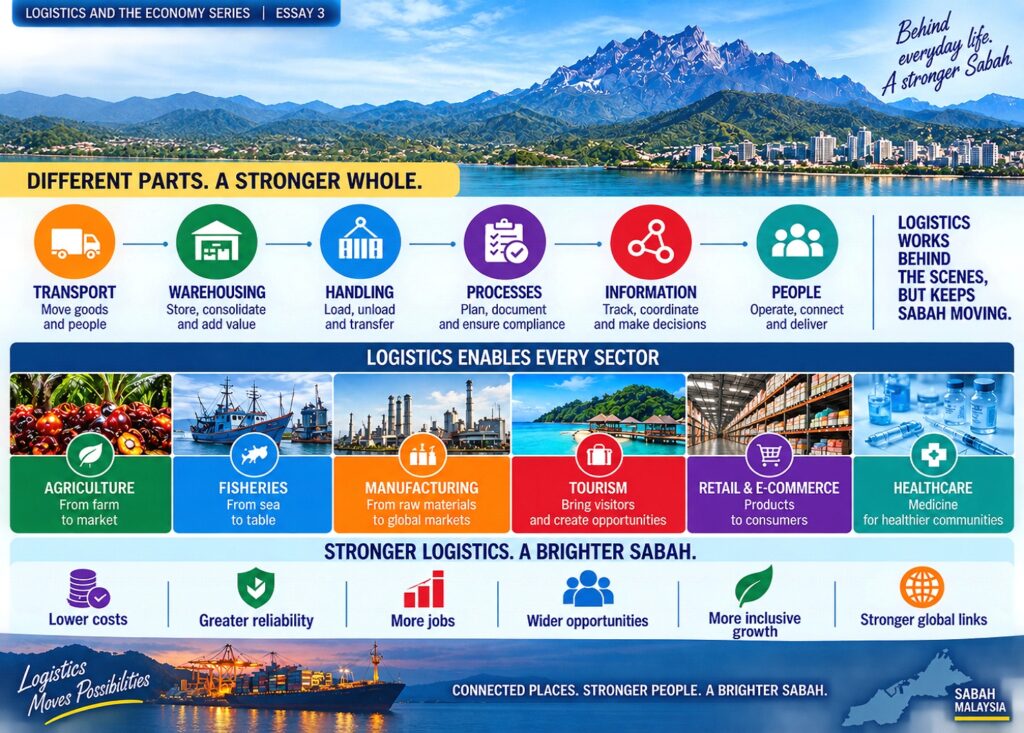
Logistics is often associated simply with trucks, ships and the movement of cargo. In reality, it is much broader. It includes transportation, warehousing, cargo handling, inventory management, cold chains, freight forwarding, customs clearance, information systems, scheduling, and the coordination of many organisations involved in moving goods from origin to destination.
Individually, these activities may appear operational. Together, they form an invisible infrastructure supporting almost every part of the economy.
More than roads and ports
Building a road does not automatically create economic value.
Its real economic value emerges when that road connects farms with collection centres, factories with ports, workers with employment and businesses with customers.
The same applies to a port. A modern port may have deep water, cranes and large container yards, but its economic effectiveness depends upon what happens beyond the port gate. Shipping schedules, customs procedures, trucking, warehousing, documentation, digital information and connections with production centres all influence how efficiently cargo moves.
Physical infrastructure provides the hardware.
Logistics provides much of the system that makes the hardware work.
This distinction is important because economic development can sometimes concentrate heavily on constructing infrastructure while paying insufficient attention to how the various pieces connect.
The economy behind everyday life
Most people rarely think about logistics when everything works properly.
We enter a supermarket and expect food to be available. A pharmacy is expected to have medicines. Restaurants expect fresh ingredients. Factories expect raw materials to arrive when required. Consumers increasingly expect goods purchased online to reach their homes quickly.
Behind these ordinary activities are complicated movements involving suppliers, warehouses, transport operators, ports, airports, distributors, retailers and information systems.
Consider something as simple as fresh vegetables reaching Kota Kinabalu from a farming area in Sabah.
The vegetables must be harvested, collected, packed, transported and distributed while maintaining quality and minimising delay. If one part of that chain fails, the consequence may appear as spoiled produce, higher prices or lower income for the farmer.
What consumers experience at the end of the chain often begins with logistics decisions made much earlier.
This is why logistics becomes most noticeable when it fails.
Every sector depends on it
Logistics is not an economic sector operating in isolation. It enables other sectors.
Agriculture depends upon logistics to move inputs to farms and produce to markets. Fisheries require landing facilities, ice, cold storage and reliable transportation. Manufacturing requires raw materials to arrive predictably and finished products to reach customers competitively.
Tourism also depends on logistics, although we seldom describe it that way. Airports, ground transportation, food supplies, hotel deliveries and the movement of people all form part of the tourism ecosystem.
Retail and e-commerce depend on warehouses, inventory systems and last-mile delivery.
Even healthcare relies upon logistics. Medicines, vaccines, equipment and other medical supplies must reach hospitals and clinics where and when they are needed.
When logistics performs well, these sectors become more efficient. When logistics performs poorly, costs and delays spread throughout the economy.
Why this matters particularly for Sabah
For Sabah, the quality of this invisible infrastructure is especially important because geography already presents significant challenges.
Economic activities are spread across a large territory. Rural production areas may be distant from major consumption centres. Sabah depends heavily upon road, maritime and air connectivity, while many supply chains extend beyond the state.
A farmer in the interior, a fisherman on the east coast and a manufacturer near an industrial centre may operate in very different environments, but they share one economic requirement: they must connect efficiently with markets.
Infrastructure helps create that connection, but it is insufficient on its own.
If a good road leads to an inefficient collection system, part of its economic potential is lost. If a modern port is connected to fragmented inland logistics, cargo still encounters delays. If agricultural production expands without adequate cold-chain capacity, producers may still struggle to reach premium markets.
The strength of the economy therefore depends increasingly on the quality of the entire system rather than on any single infrastructure project.
From infrastructure planning to systems planning
This suggests that Sabah’s development planning should increasingly ask not only, “What infrastructure should we build?” but also:
“How will this infrastructure connect with the rest of the economy?”
That changes the conversation.
A road project becomes part of a supply chain. A port becomes part of an industrial ecosystem. An airport becomes part of tourism, trade and high-value cargo networks. Digital platforms become part of infrastructure because information must move alongside goods.
Data also becomes increasingly important. Businesses need to know where cargo is, when ships will arrive, where delays occur and where capacity is available.
Modern logistics therefore combines physical connectivity with digital connectivity.
Making the invisible visible
Perhaps one reason logistics receives insufficient attention is precisely that successful logistics is largely invisible.
We notice the bridge, but not the scheduling system. We see the port, but not the information connecting shipping lines, customs, haulers and warehouses. We see products on supermarket shelves, but rarely the supply chains that placed them there.
Yet these unseen connections influence prices, competitiveness, investment, employment and ultimately living standards.
For Sabah, recognising logistics as economic infrastructure would represent an important change in development thinking.
It means planning roads, ports, airports, industrial areas, rural production, digital systems and logistics services as parts of an interconnected whole.
The objective is not simply to move goods faster.
It is to make the entire economy more connected, reliable and productive.
Physical infrastructure gives Sabah the pathways.
Logistics turns those pathways into economic possibilities.
And although much of it remains invisible, it may be among the most important infrastructure supporting Sabah’s future prosperity.