By WU VUIDE
TUARAN: The Sabah Government has strengthened the Native Courts through the Native Courts Bill 2026, passed by the State Legislative Assembly last July.
Chief Minister Datuk Seri Hajiji Noor said the passing of the Bill was historic, ending the government’s long wait to strengthen the native customary legal system.
He said the move was aimed at modernising the indigenous communities’ traditional legal system to ensure it remained effective, relevant and authoritative in keeping with changing times.
“This effort is also aimed at ensuring that the jurisdiction of the Native Courts is clearer, structured and capable of preserving and upholding local customary laws,” he said when officiating at the Tuaran River Conservation Project and the New Tuaran Town Car Park.
Hajiji said several major reforms had been achieved through the new enactment, including a more robust and professional judicial structure.
He said the court structure had been reorganised to include the Native District Court, Native High Court and Native Court of Appeal, as well as the establishment of the positions of Chief Justice and Chief Judge of the Native Courts, Native Court Counsel and Registrar.
“The appointment of judges is now being planned based on merit to ensure a high level of integrity and credibility,” he said.
He said the reforms also involved a clearer separation between administrative and customary functions and judicial responsibilities.
However, the traditional roles of customary officials, such as District Chiefs and Native Chiefs, would be preserved to maintain the customary foundations of Sabah’s communities.
He said that, in line with the legal transformation, the government had also allocated funds to upgrade court buildings. This included a proposal to upgrade the Sabah Native Judiciary Complex and construct new courts in several districts.
Hajiji said the reforms would enhance the standing of customary institutions and place native customary law in a more respected and equal position within the country’s legal system.
He said the government’s development agenda was not confined to physical and material development but also included efforts to preserve the identity, heritage and customary legal institutions of Sabah’s indigenous communities.
“Sabah is a land rich in cultural diversity, customs and the unique heritage of its indigenous communities. Therefore, preserving the dignity and sovereignty of customary law is a major responsibility shouldered by the government today,” he said.
Hajiji said the opening of the Tuaran River Conservation Project and the New Tuaran Town Car Park demonstrated the government’s commitment to comprehensive development, encompassing modern infrastructure and environmental sustainability.
He said the Tuaran River was one of the district’s important natural assets, not only for its environmental significance but also because it formed an integral part of the lives and history of the local community.
He said climate change and riverbank erosion required proactive government action.
Therefore, river conservation efforts must be undertaken seriously to ensure the area remained clean, well preserved and free from activities that could damage the environment.
Hajiji said the bridge constructed under the project was inspired by the traditional bubu fish trap, a fishing tool closely associated with the local community.
He said the Tamu Tuaran Bridge would serve as a new landmark for the town and connect communities across the river with the Tamu Tuaran area, while facilitating the movement of residents, particularly pedestrians.
On the new car park, he said the facility was provided in response to Tuaran town’s rapid economic growth and increasing activities.
He said the growing number of vehicles, particularly on tamu days and weekends, often caused traffic congestion. The town also continued to attract people carrying out daily activities, including business and commercial transactions.
Hajiji also reiterated his call for every district in Sabah to develop and promote tourism products and experiences with distinctive identities as part of preparations for Visit Sabah Year 2027.
He said Tuaran had attractive beaches, recreational centres, cultural and natural heritage, as well as economic activities involving agriculture, fisheries and tourism that could be further developed.
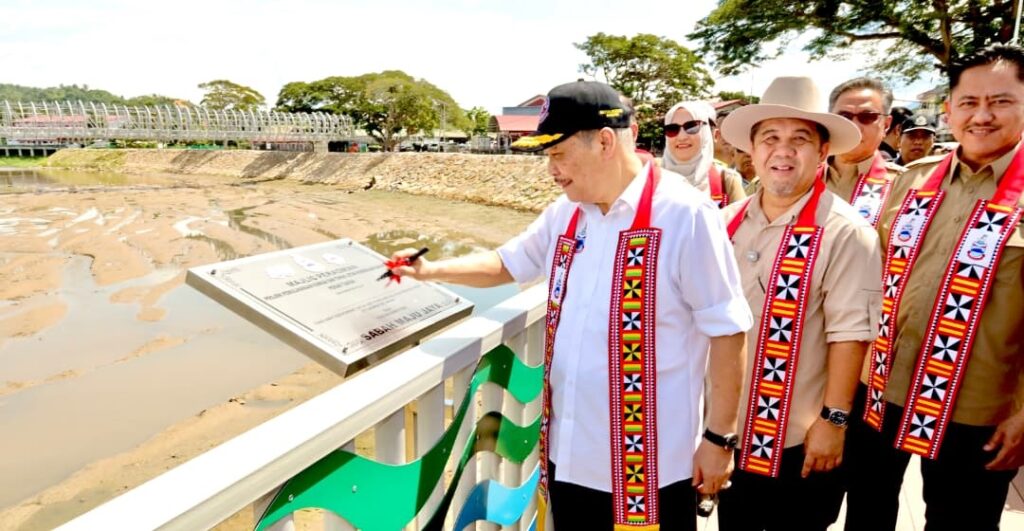
Hajiji signs the plaque to officiate the Tuaran River Conservation and New Tuaran Town Car Park projects.