By WU VUIDE
KOTA KINABALU: The State Government aims to reduce Sabah’s absolute poverty rate to between three and five per cent by 2030, said Chief Minister Datuk Seri Hajiji Noor.
He said the effort required measurable annual targets to reduce the number of poor heads of households under the Sabah Poverty Eradication Plan 2027–2030.
“As of Oct 15, 2026, Sabah still recorded 55,555 heads of households (KIR) classified as poor.
“I want this figure to serve as one of the baseline data sets for establishing key performance indicators (KPIs),” he said when officiating at the 2026 People’s Well-being and Transformation Symposium (KESTRA) at the Sabah International Convention Centre (SICC) here yesterday.
Hajiji said every ministry and agency involved must set intervention targets and report actual outcomes to help households escape poverty sustainably.
He said implementing the exit policy did not mean government assistance would automatically cease once a recipient’s income exceeded the poverty line. Instead, a gradual transition, continuous monitoring and appropriate support must be provided.
Hajiji said all government assistance programmes, including Rumah Mesra SMJ, Sentuhan Kasih Rakyat (Syukur), educational assistance, scholarships, zakat, welfare aid, skills training and entrepreneurship programmes, must be coordinated under a single intervention framework.
He said every ministry and agency must have clearly defined responsibilities, including designated lead agencies, implementation timelines, funding sources and KPIs that measured improvements in living standards and household incomes.
He also stressed the importance of exploring blue economy sectors, such as fisheries, aquaculture and marine tourism, to generate income for the people.
He said attention must be given to Sabahans who had migrated to Peninsular Malaysia in search of employment by creating more job opportunities in the state so they would no longer have to seek work elsewhere.
He told all ministries, departments and agencies that 2030 was not a deadline to wait for, but a target that demanded action starting now.
Hajiji said the government continued to strengthen the Sabah Government Scholarship programme by increasing its annual allocation from RM55 million in 2021 to RM160 million in 2026.
He said the total scholarship allocation from 2021 to 2026 had reached RM625 million, benefiting 16,207 students, including 5,412 scholarship recipients in 2026.
Hajiji also urged all ministries, departments, statutory bodies and agencies under the State Government to cooperate fully in coordinating data and implementing poverty eradication programmes to ensure assistance was delivered in a more systematic and targeted manner.
“I have entrusted the Sabah Maju Jaya (SMJ) Secretariat with the responsibility of coordinating the state’s poverty eradication agenda.
“However, comprehensive cooperation among all agencies still needs to be strengthened, particularly in sharing recipient data, information on assistance already provided and reporting on intervention outcomes,” he said.
Hajiji said the successful elimination of hardcore poverty among 22,510 heads of households identified under the Sabah Hardcore Poverty Eradication Programme 2023 demonstrated the effectiveness of cooperation among all parties.
He said the target was achieved on July 31, 2024, in less than a year, through inter-agency cooperation in data sharing, field verification, assistance coordination and appropriate interventions.
The achievement involved 22,510 heads of households and 94,315 household members, bringing the total number of individuals in these households to 116,825.
He said the government would strengthen the use of eKasih data and the Sabah State Database (PADANS) as official reference sources to identify overlapping assistance, coverage gaps and follow-up actions required for each household.
Hajiji said 54 assistance-providing agencies from the State and Federal Governments, as well as industry players, were involved in 134 assistance interventions covering the five pillars of the Hardcore Poverty Eradication Programme: housing, education, employment, welfare and finance, and entrepreneurship and training.
He said efforts to develop a state poverty assessment framework must also be strengthened.
Based on official statistics released by the Department of Statistics Malaysia, Sabah’s absolute poverty rate declined from 19.7 per cent in 2022 to 17.7 per cent in 2024, while the hardcore poverty rate fell from 1.2 per cent to 0.7 per cent.
Sabah continued to record a poverty rate above the national level and the highest among all states.
Hajiji said the 13 additional hardcore poverty indicators for Sabah, agreed upon in 2023, should be used as assessment and profiling tools to identify the underlying causes of poverty in each family.
He said all findings and recommendations from the symposium must be consolidated into a practical action plan for the State Government’s consideration and presented to the State Cabinet to ensure clear follow-up action.
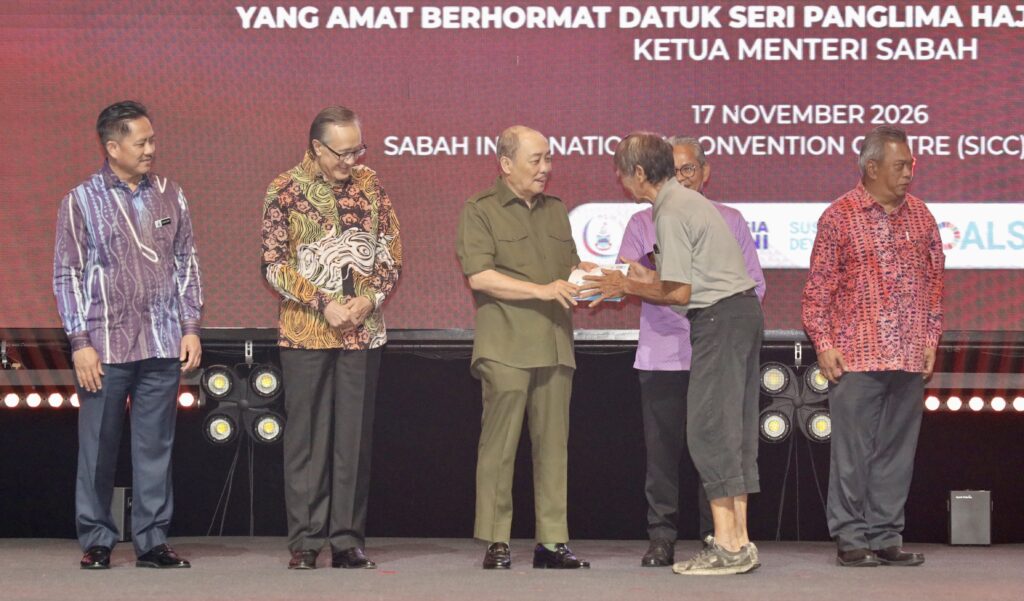
Hajiji presents government assistance to a recipient during the opening ceremony of KESTRA as other guests look on.