By WU VUIDE
KOTA KINABALU: The Sabah Climate Change Action Council (SCAC) has convened six meetings since its establishment and is advancing key policies, legislation and institutional frameworks to strengthen the state’s climate governance, Chief Minister Datuk Seri Hajiji Noor said.
He said the council, approved by the State Cabinet in 2022, has undertaken two major pilot studies — a Climate Change Vulnerability Assessment and the Sabah Greenhouse Gas (GHG) Inventory Report 2024 — the first subnational report of its kind in Malaysia.
“The findings provide, for the first time, a comprehensive understanding of emission levels across various economic sectors and confirm Sabah’s status as a carbon-negative (net sink) state,” he said, responding to a question from Sook Assemblyman Datuk Seri Arthur Joseph Kurup during the question-and-answer session at the State Legislative Assembly sitting yesterday.
Hajiji said the studies led to the formation of a working committee to draft climate legislation, culminating in the passage of the Sabah Climate Change and Carbon Governance Enactment 2025 in July last year.
He said SCAC is chaired by the State Secretary, with Permanent Secretaries and heads of departments from various ministries and agencies as members, to enhance coordination of climate action at the state level.
Among its roles, he said, are setting direction and coordinating mitigation and adaptation initiatives, serving as the state’s focal point for climate policy implementation, and facilitating inter-agency collaboration while promoting socio-economic opportunities from low-carbon development.
Hajiji said mitigation and adaptation plans are being developed with the Ministry of Natural Resources and Environmental Sustainability (NRES), based on vulnerability assessments, given Sabah’s exposure to climate risks.
He added that efforts are underway to strengthen the capacity of relevant agencies in collecting GHG inventory data to align with national reporting requirements under the United Nations Framework Convention on Climate Change (UNFCCC).
“At the same time, Sabah-specific variables are being identified to improve the accuracy of future GHG inventories, while the council continues evaluating mitigation and carbon project proposals,” he said.
Hajiji said that following the gazettement of the 2025 enactment, the State Government will establish the Sabah Climate Registration and Inventory Centre (SaCRIC) to oversee enforcement and regulate carbon-related activities.
He said regulations are being drafted to operationalise the centre, which will support monitoring, reporting and compliance.
“The council will also serve as the apex body in formulating the State Climate Change Policy, aligned with Sabah’s ecological and socio-economic context, while ensuring consistency with national frameworks through close cooperation with the National Designated Authority,” he said.
He added that this includes coordination in reporting, access to climate financing and compliance with Malaysia’s commitments under the UNFCCC and the Paris Agreement.
Hajiji’s speech was read by Assistant Minister to the Chief Minister Datuk Ceasar Mandela Malakun.
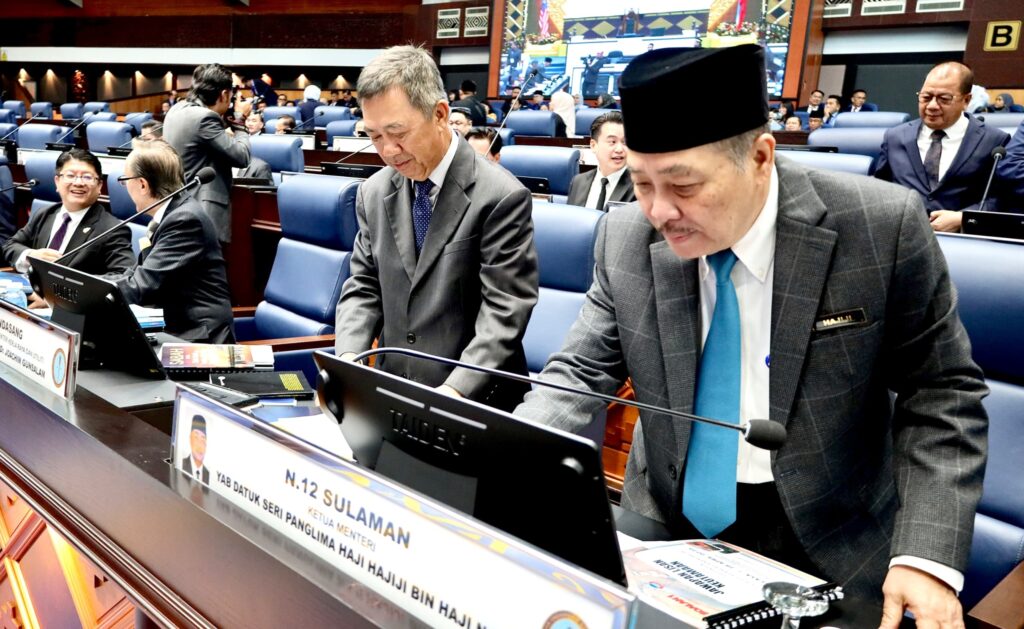
Hajiji (right), taking his seat during the sitting.