By PAUL MU
BUKITTINGGI: One thousand women dressed in traditional attire have showcased Minangkabau cultural heritage during the culmination of the Jam Gadang centenary celebrations.
The colourful procession was held at Pelataran Jam Gadang in conjunction with the 4th International Minangkabau Literacy Festival (IMLF) 2026 from June 3 to 7.
Participation by Bundo Kanduang, or “true mothers”, increased by more than 50 per cent compared with previous editions, said local tour guide Ahmed Ghani.
“The atmosphere is much livelier this year because there are more participants,” he said.
Ghani said the celebration attracted participants from Riau, South Sumatra, Palembang, Tangerang and Jakarta.
Others came from districts and cities throughout West Sumatra.
The increased turnout reflected the festival’s growing appeal beyond its traditional Minangkabau heartland, he added.
Tourist arrivals also rose significantly, with visitors from Indonesia and abroad attending the celebrations.
Many enthusiastic participants were working adults who took leave to attend the occasion.
Although they now live elsewhere, many returned to their ancestral homeland to celebrate their heritage.
Several represented chapters of Ikatan Keluarga Minang (IKM), a network for Minangkabau communities outside West Sumatra.
“They have come together from various places to celebrate the Jam Gadang centenary,” Ghani said.
Local English teacher Siti Masitah said Jam Gadang attracts visitors through its architecture, history and folklore.
One popular story concerns the Roman numeral “IIII” appearing instead of “IV” on the clock face.
Siti said local accounts link the numeral to four workers who reportedly died during construction.
“That is one story people tell,” she said.
Completed in 1926, the clock tower stands 26 metres tall.
Siti said Queen Wilhelmina of the Netherlands presented the clock to the Regent of Bukittinggi.
The clock mechanism came from the Netherlands, while local workers built the structure.
“A visit to Bukittinggi is not complete without stepping foot at Jam Gadang,” she said.
The tower remains the city’s most recognisable landmark and a popular photography spot.
Its architecture evolved from Dutch and Japanese influences to a Minangkabau-style roof after independence.
The roof design is inspired by buffalo horns, a symbol closely associated with Minangkabau culture.
Siti said the surrounding square underwent major changes about a decade ago.
The park was redesigned during the administration of Mayor Ramlan Nurmatias.
She also highlighted Jam Gadang’s role as a venue for cultural performances.
Traditional drums, martial arts demonstrations and flute music are regularly featured there.
The performances attract both local residents and tourists.
Siti said this was her first time attending the International Minangkabau Literacy Festival.
She had previously been occupied with teaching commitments.
Tourist arrivals declined sharply during the Covid-19 pandemic, she said.
However, the centenary celebration has helped revive international interest in Bukittinggi.
“This year is especially meaningful as it marks 100 years since the tower was built in 1926,” she said.
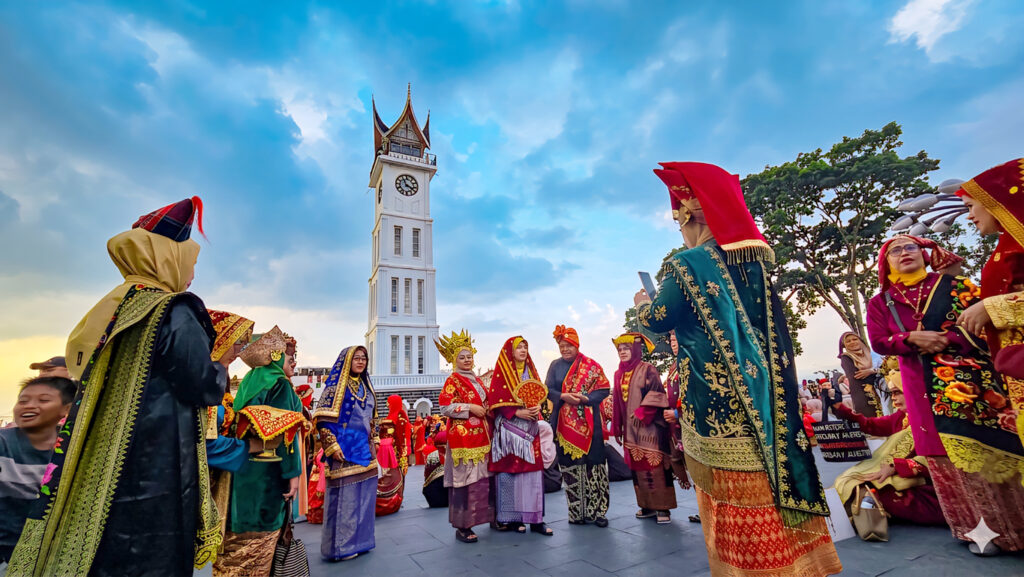
One thousand women processing at Jam Gadang square.

Tour guide Ahmed Ghani said the celebration attracted participants from Riau, South Sumatra, Palembang, Tangerang and Jakarta.

Local English teacher Siti Masitah said Jam Gadang attracts visitors through its architecture, history and folklore.