KOTA MARUDU: The Sabah Government remains deeply committed to uplifting rural communities, particularly paddy farmers and small-scale agriculturalists who form the backbone of the state’s food supply, said Deputy Chief Minister II Datuk Dr. Joachim Gunsalam.
He emphasized that multiple initiatives are being rolled out under the Second Pillar of the Sabah 2025 Budget—Inclusive and Equitable Development—to safeguard the welfare of these groups while bolstering the state’s food security.
“The State Government, under the leadership of the Chief Minister, highly values the contributions of paddy farmers and smallholders. We are intensifying efforts to empower them through targeted programs,” he stated when officiating the 2025 Kota Marudu District-Level Kaamatan Festival at the Kota Marudu Community Hall yesterday.
As Deputy President of the Kadazan Dusun Cultural Association (KDCA), Joachim highlighted key measures, including increasing the Paddy Field Incentive from RM18 million to RM26 million annually. This initiative benefits 22,500 farmers yearly with a subsidy of RM494 per hectare.
“Additionally, the government is rehabilitating 438 hectares of abandoned paddy fields in Papar, Tuaran, and Sook. These efforts are projected to yield 2,190 metric tons of rice per season, sufficient to meet the needs of 15,330 residents,” he added.
Joachim noted that the revival of the Sabah Rice and Rice Board (LPBS) further strengthens the paddy sector. A RM32.5 million allocation has been approved for LPBS operations, including the purchase of 60 modern machinery units and irrigation system upgrades in six major rice-producing districts, including Kota Marudu.
“These steps are expected to raise Sabah’s rice Self-Sufficiency Level (SSL) to 30% by 2026,” he explained.
Concurrently, RM7.49 million has been channelled to the Sabah Agriculture Institute and Agricultural Vocational Training Centres to cultivate a semi-skilled agricultural workforce.
“These initiatives are part of the state’s broader agenda to reinforce Sabah’s food security, reducing reliance on external supplies and fostering self-sufficiency through local resources,” he said.
Joachim stressed that the government’s commitment reflects its dedication to empowering rural economies, curbing food import dependency, and ensuring a sustainable future for Sabahans.
Earlier, he underscored that the Kaamatan festival symbolizes unity and gratitude toward the farming community, which lies at the heart of Sabah’s cultural identity.
“Kaamatan is for everyone. It is not just an annual celebration but a reflection of gratitude, cooperation, and respect for cultural heritage that must be preserved for future generations,” he concluded. – James Leong
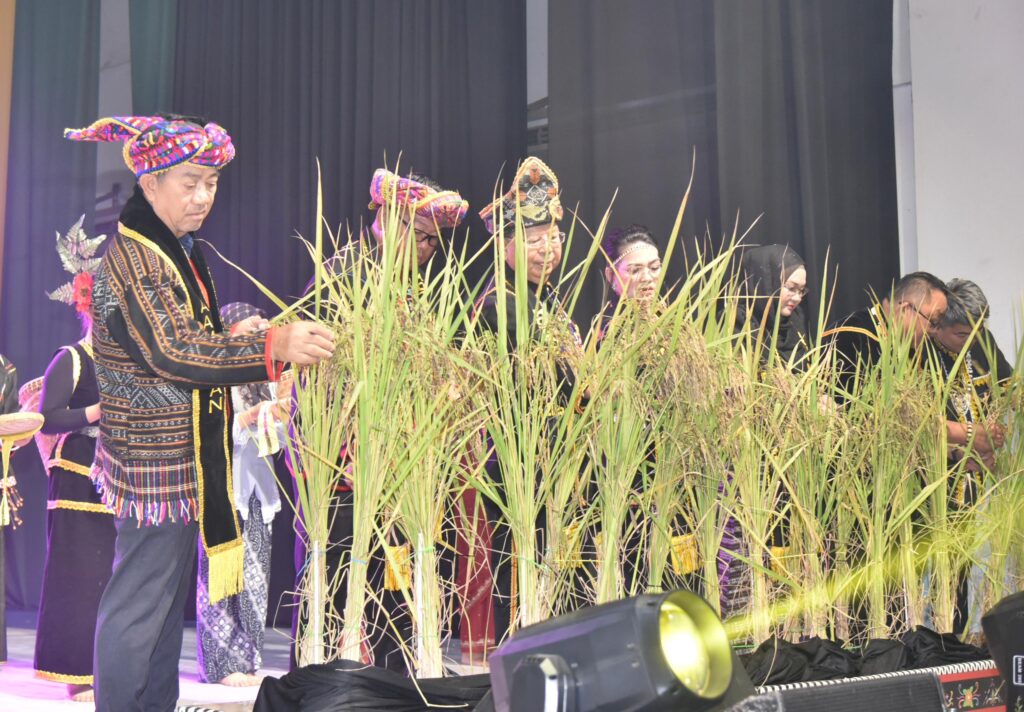
Joachim (left), officiates the traditional rice harvesting ceremony (mongomot) alongside other invited guests