SANDAKAN: The Sabah Forestry Department (SFD) has released its 306-page 2025 Annual Report, presented by Chief Conservator of Forests Datuk Zulkifli Suara at the Forestry Headquarters yesterday.
The comprehensive document details a year of significant milestones, including the official recognition of Pin Supu Forest Reserve in Kinabatangan as Malaysia’s first terrestrial IUCN Green List of Protected and Conserved Area—a prestigious global accolade from the International Union for Conservation of Nature (IUCN) for excellence in conservation management.
The State has maintained its forest cover at 63 percent, the highest among Malaysia’s three regions, while progressing toward achieving 30 percent Totally Protected Areas (TPAs) through forthcoming gazettement. These efforts align with the State’s commitment to addressing climate change and advancing the UN Sustainable Development Goals.
In legislative developments, the Forest (Amendment) Enactment 2025 was passed to regulate forest-based carbon activities and establish a carbon trading framework. Forest-based carbon activities in reserves, state land, and titled land will now be licensed under terms safeguarding state interests. Concurrently, Sabah enacted the Climate Change and Carbon Governance Enactment 2025, positioning the State as a leader in environmental conservation and climate resilience.
The Sabah Timber Legality Assurance System (TLAS) was upgraded to Sabah TLAS+, with the department launching its e-Removal Pass System in December to align with EUDR international standards. Despite challenging global economic conditions, forest revenue reached RM164.7 million in 2025.
Throughout the year, SFD organised numerous seminars, workshops, and dialogues, including the International Conference on the Green Heart of Borneo (22-23 October) themed “Advancing Climate Resilience, Conservation and Sustainable Livelihood,” and the State-level International Day of Forests at UMS on 24 April under the theme “Forests and Food.” The Majlis Apresiasi Perhutanan (MAPT) 2025 was officiated by the State Secretary representing the Chief Minister. Under the five-year Greening Malaysia-100 Million Tree Planting Campaign (2021-2025), nearly 27 million trees were planted in Sabah, achieving 67 percent of the State’s 40 million trees target.
The department garnered multiple accolades in 2025, including the Special Award for Best Human Resource Management, a 5-Star Rating for its Human Resource Information System (SM2) from the State Public Service Department, and Best Record Management from Sabah State Archives. It also secured first runner-up for the Independent Web Innovator Award from the State Ministry of Science, Technology and Innovation.
The year marked the inception of the Integrated Landscape Management for Sustainable Food Systems, Land Use and Restoration Project (FOLUR) in Sabah. Development projects under the 12th Malaysia Plan (2021-2025) were successfully implemented, achieving 99 percent expenditure for state-funded projects and 99.8 percent for federal-funded projects, comprising 30 projects from each funding source.
Forest protection and enforcement initiatives were strengthened through aerial drone surveys, honorary forest rangers, forest checking stations, multi-sector partnerships, and relevant legislative amendments. The research arm produced 113 publications and scientific reports, maintained over 50 research collaborations, and conducted more than 40 research activities, while the Rainforest Discovery Centre delivered 107 environmental education programmes. The Sabah Forestry Institute (FORiNS) graduated 38 individuals from forestry courses in 2025.
Zulkifli extended his appreciation to all department personnel and stakeholders for their contributions to sustainable forest management. The Annual Report 2025, accessible on the SFD website with interactive navigation from its Table of Contents, serves as the department’s comprehensive Key Performance Index and report card, showcasing all project implementations, activities, and achievements throughout the year. – James Leong

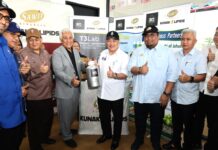
Zulkifli (3rd left), with his deputies and the editorial team showing the Annual Report.