By WU VUIDE
TUARAN: The Sabah Government is exploring a proposal to include Tuaran district in the Kinabalu UNESCO Global Geopark (KUGGp), Chief Minister Datuk Seri Hajiji Noor said.
The move follows preliminary findings from the Geo-Sulaman Scientific Expedition (EGOS 2025) conducted in April 2025.
The expedition found that Tuaran has distinctive geological features, rich biodiversity, significant cultural heritage and valuable community knowledge.
“These assets merit careful study, documentation and, where appropriate, inclusion within a broader conservation and sustainable development framework to strengthen Sabah’s ecological and ecotourism connectivity,” he said.
He was speaking at the closing ceremony of the KUGGp Revalidation Mission at the Rumpun Bajau Sama Cultural Centre in Lok Batik.
His speech was delivered by Tourism, Culture and Environment Minister Datuk Jafry Ariffin.
At present, he said, KUGGp covers about 4,750 square kilometres across three districts – Kota Belud, Kota Marudu and part of Ranau.
Managing an area of this scale, involving multiple administrative jurisdictions and diverse communities, requires a clear, coordinated and long-term strategy.
Accordingly, Hajiji said the Kinabalu UNESCO Global Geopark Management Plan 2026–2035 had replaced the Interim Management Plan 2021–2025.
“The new plan integrates the geopark’s principal pillars – resource conservation, research, education and socio-economic development – and will be implemented in three phases: foundation-building, acceleration and transformation.
“These will be guided by nine strategic themes towards 2035,” he said.
Hajiji said the KUGGp revalidation mission which began on Aug 10, was not merely about retaining its UNESCO designation.
Instead, it was an opportunity to strengthen institutions, improve management, deepen community participation and ensure UNESCO’s values were translated into tangible action.
“Let us commit to converting international recognition into stronger conservation, improved education, resilient communities and fairer economic opportunities for our people.
“Our aspiration is clear. By 2035, the Kinabalu UNESCO Global Geopark should be a globally recognised model of integrated landscape management, where conservation, community well-being and sustainable prosperity reinforce one another,” he said.
Hajiji said the KUGGp had been strengthened with a clear governance structure.
Key committees covering infrastructure and community empowerment, conservation and geotourism, tourism and promotion, and networking and collaboration operate under the Tourism, Culture and Environment Ministry.
They are guided by the Sabah Geopark Steering Committee.
“This structure reflects an important principle: the geopark is a shared responsibility,” he said.
A key initiative has been the establishment of Infrastructure and Community Empowerment Committees coordinated by the respective District Offices across the KUGGp territory.
“Through this mechanism, local development needs and community capacity-building priorities are identified and coordinated, enabling more integrated action that directly responds to local needs.
“Coordinated committee efforts have expanded programmes such as the Geopark Outreach Programme and Geopark Camp.
“They have also strengthened collaboration with industry players, site operators, educational institutions and other stakeholders through the Geopark Partner and Geopark School initiatives.
“These programmes are important steps towards building skills, creating livelihoods and broadening opportunities for local communities,” he said.
According to Hajiji, UNESCO recognition must deliver more than international prestige.
It must provide meaningful and sustainable opportunities for communities through responsible tourism and geotourism, community-based enterprises, local product development, cultural experiences, education, skills training, employment and participation in decision-making.
“This approach aligns with the Sabah Maju Jaya (SMJ) 2.0 development plan for 2026–2030, which aims to drive a more competitive, inclusive and sustainable Sabah while ensuring development contributes to the welfare of our people.
“For KUGGp, that means expanding market access, strengthening local entrepreneurship, improving appropriate infrastructure and ensuring communities are active partners in shaping development, not merely passive beneficiaries,” he said.
He expressed gratitude to UNESCO evaluators Dr Zhang Yuanhai and Dr Atsuko Niina for their expertise and due diligence during the KUGGp Revalidation Mission 2026.
He said every UNESCO Global Geopark undergoes revalidation every four years.
The process is essential not only to maintain international recognition but also to ensure the geopark continues to meet UNESCO’s standards, principles and responsibilities.
“We also thank the scientific advisers of KUGGp, Sabah Parks as the lead agency, Federal and State Government agencies, institutions of higher learning, District Offices, local authorities, community leaders and local communities.
“We also thank every organisation and individual whose efforts have made this revalidation mission a success,” he said.
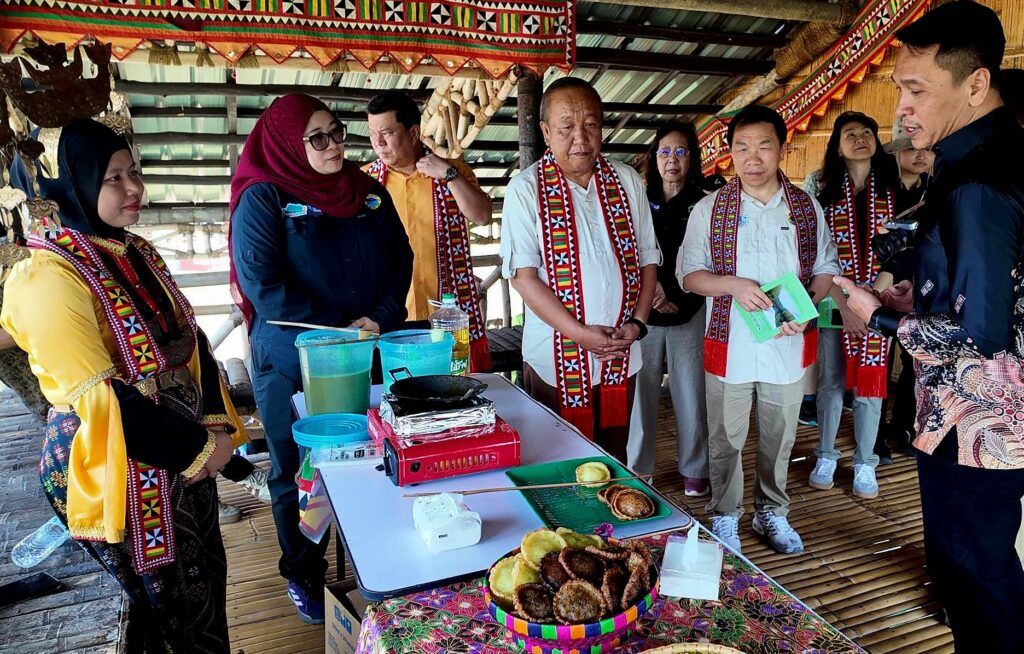
Jafry visits an exhibition booth set up in conjunction with the conclusion of the KUGGp revalidation process.