KOTA KINABALU: Sabah can plan roads and protect wildlife at the same time, if scientific evidence reaches planners before routes and budgets are fixed.
That was the central question at a one-day workshop in Kota Kinabalu.
The Institute for Development Studies Sabah (IDS) and 10 civil society organisations under the Humans, Habitats and Highways (3H) Coalition organised the meeting.
Almost 60 people attended from government, research institutions and civil society.
IDS chief executive officer Datuk Dr Ramzah Dambul said the aim was to close the gap between evidence and decisions.
“The issue is timing,” he said. “Data must reach the right people before alignments, designs and budgets are finalised.”
Agencies present included the State Economic Planning Unit (UPEN), Sabah Maju Jaya Secretariat (SSMJ), Environment Protection Department (EPD), Lands and Surveys Department (JTU), and Sabah Forestry Department (SFD).
They outlined how road planning works in practice and where information fails to get through.
Forever Sabah chief executive facilitator Cynthia Ong said civil society wants its evidence used earlier.
“We collect this information to inform planning, not to comment after the budget and design are set,” she said.
She cited the Pan Borneo Highway through Tawai Forest Reserve. Despite years of engagement, efforts to reroute the highway away from the reserve were unsuccessful.
Lessons from Tawai can still be applied elsewhere, said Danau Girang Field Centre director and Cardiff University professor Dr Benoit Goossens.
“It is not too late for the Kalabakan-Maliau stretch of Phase 3.
“We understand the alignment and budget are not yet finalised. There is still time to work with planners, contractors and consultants to respect both nature and people,” said Benoit.
Evidence from Tawai was presented by Universiti Malaysia Sabah senior lecturer and Seratu Aatai director Dr Nurzhafarina Othman.
A project commissioned to Seratu Aatai and Danau Girang Field Centre, supported by Yayasan Hasanah and the Finance Ministry , tracked three elephants — one male, two females — before and during construction.
“The three elephants moved out of the area during early construction.
“We also mapped hotspots of elephant activity that overlap with the highway alignment,” said Nurzhafarina.
That data has immediate use. Her team has advised against guardrails at specific locations where they would block elephant movement, especially calves.
“If Sabah wants a greener development agenda, we must bring development and biodiversity together from the beginning.
“We cannot consider biodiversity only after the decisions are made,” she said.
WWF-Malaysia scientist Dr Cheryl Cheah said the tools already exist.
She pointed to the Handbook to Mitigate the Impacts of Roads and Railways on Asian Elephants, developed by the IUCN WCPA/SSC Asian Elephant Transport Working Group.
The workshop will produce practical recommendations on when, where and how to introduce scientific evidence into linear infrastructure planning in Sabah. – Wu Vuide
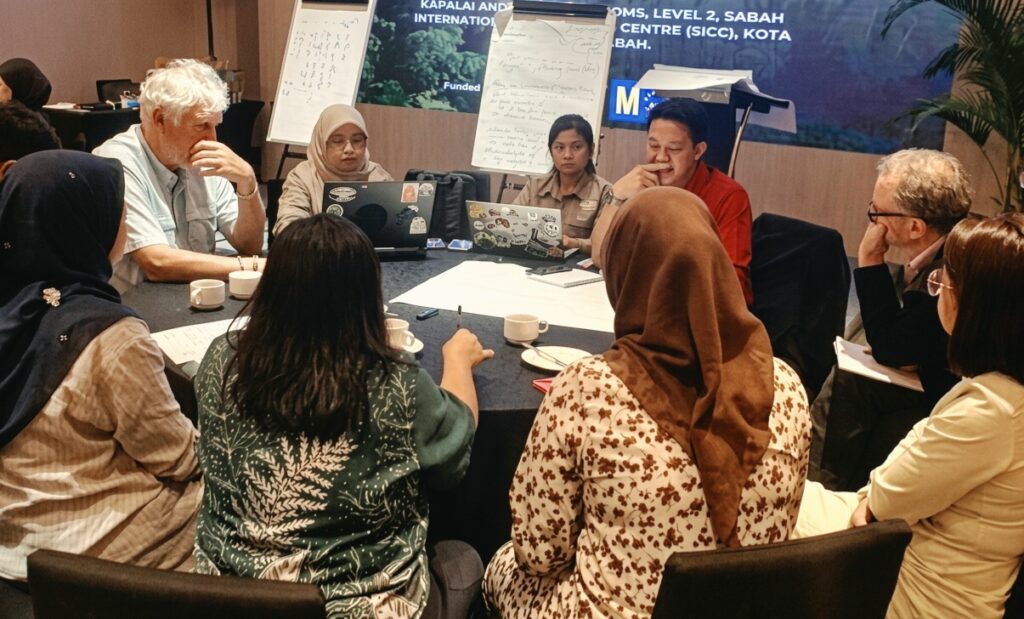
A group discussion on road planning and wildlife protection.