The cost of distance: Why Geography matters to Sabah’s economy – Part 4
KOTA KINABALU: Distance is usually measured in kilometres. For an economy, however, distance is better measured in terms of time, cost, reliability, and access.
This distinction matters greatly to Sabah.
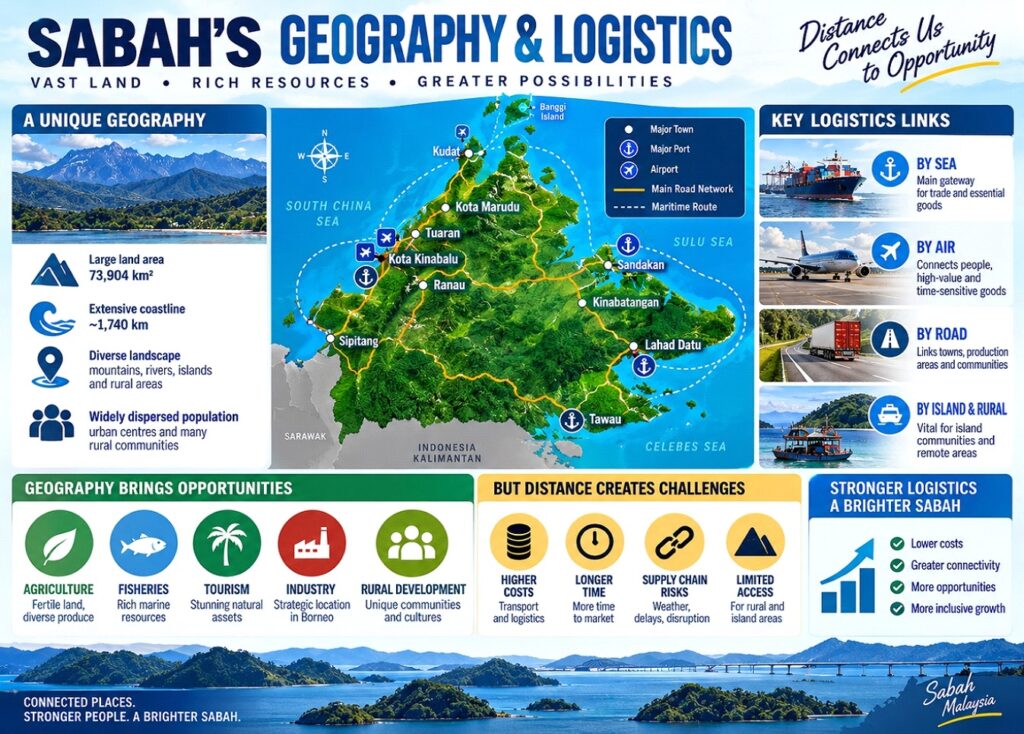
Sabah is geographically large; its population and economic activities are widely dispersed, and many production centres are separated from major markets by considerable distances. Rural communities produce agricultural goods far from urban consumers. Fisheries operate along an extensive coastline. Industries depend on inputs arriving from elsewhere, while many finished products must travel by sea or air to reach larger markets.
Geography, therefore, is not simply a feature of Sabah’s landscape. It is part of our economic reality.
The question is not whether we can change geography. We cannot. The more useful question is: can we reduce the economic cost of distance?
Distance is more than kilometres
Imagine two farmers producing the same crop at the same quality and cost.
One is located near a major market with good roads, reliable transport, and easy access to collection and storage facilities. The other is several hours away, with fewer transport options and a more complicated journey to market.
Their products may be identical at the farm gate, but their economic circumstances differ greatly.
For the second farmer, distance adds transport costs, longer delivery times, a higher risk of spoilage, and possible dependence on several intermediaries.
The true distance between producer and consumer therefore cannot be measured by kilometres alone.
We might think of it this way:
Physical Distance + Time + Cost + Reliability = Economic Distance
And economic distance affects competitiveness.
Sabah’s geography carries a price
Sabah’s geography gives us enormous advantages. We possess extensive coastlines, rich marine resources, fertile agricultural areas, forests, tourism assets and a strategic position within the wider Borneo and Southeast Asian region.
But the same geography also creates logistical challenges.
Economic activity is spread across the west coast, the interior, the east coast, and the northern districts. Some production areas are far from Kota Kinabalu and other major centres. Sabah’s external trade also relies heavily on maritime transport.
Every additional movement adds cost.
A product may travel from a farm to a collection centre, then to a processor or warehouse, then to a port, before beginning another journey to its final market.
The greater concern is therefore not distance itself but the friction encountered along that distance.
A 300-kilometre journey on a reliable transport corridor may be economically “shorter” than a 100-kilometre journey characterised by congestion, poor road conditions, uncertain schedules, or multiple handling points.
The hidden cost in everyday prices
The cost of distance eventually appears somewhere in the economy.
Sometimes businesses absorb it through lower margins. Sometimes producers receive lower prices. Frequently, consumers ultimately pay for it.
Consider goods brought into Sabah.
They must be shipped, unloaded, cleared, stored and distributed. From the port or warehouse, they may need to travel hundreds of kilometres to reach communities elsewhere in the state.
Transport cost becomes embedded in the final price.
The same process works in reverse for Sabah’s exports. If it costs more to bring a Sabah product to market than a competing product from elsewhere, Sabah starts at a disadvantage before the product even reaches the customer.
This is why logistics efficiency matters beyond transport operators.
It influences the cost of living, business competitiveness and household income.
Distance also determines opportunity
The cost of distance is not confined to freight.
It also affects access to employment, education, healthcare, tourism and investment.
A rural community poorly connected to an economic centre faces more than transport inconvenience. Its residents may have fewer employment opportunities, while businesses struggle more to reach customers and obtain supplies.
Similarly, a beautiful tourism destination may possess tremendous natural attractions, but poor accessibility can limit its economic potential.
Connectivity therefore influences the geography of opportunity.
Where connections are strong, economic activity tends to become easier. Where connections are weak, distance becomes a barrier.
This matters if Sabah wants development to extend beyond the major urban centres.
Making Sabah economically smaller
We cannot physically move Tawau closer to Kota Kinabalu. We cannot shorten Sabah’s coastline or relocate rural communities nearer to ports.
But logistics can make Sabah economically smaller.
Better roads can reduce journey times. More reliable shipping can reduce uncertainty. Cargo consolidation can lower transport costs per unit. Cold-chain systems can enable agricultural and fishery products to travel farther without losing quality.
Digital systems can reduce another kind of distance.
Documents can move electronically. Cargo can be tracked. Businesses can coordinate transport before goods arrive. Producers can connect directly with customers and gather market information without being physically close.
In this sense, logistics does not eliminate distance.
It reduces the penalty of distance.
From infrastructure to connectivity
This also changes how we should think about infrastructure.
The objective should not simply be to build more roads, ports and airports. The question should be whether these investments reduce economic distance.
A road that shortens the journey between a production area and a market has an economic purpose. A port that provides more reliable access to regional shipping networks reduces distance in another way. Better rural collection systems can bring small producers closer to larger supply chains.
The key word, therefore, is not merely infrastructure.
It is connectivity.
Infrastructure is what we build. Connectivity is what that infrastructure enables.
Geography need not become destiny
Sabah will always face geographical challenges. A large territory, dispersed population and dependence on sea and air links cannot simply be wished away.
But geography need not determine our economic destiny.
The real policy challenge is to identify where distance imposes the greatest economic penalty and systematically reduce that penalty through better infrastructure, logistics, technology and coordination.
This matters especially for rural Sabah. Reducing economic distance between farms, fishing communities, processing centres and markets can bring more people into the mainstream economy without requiring them to relocate.
Sabah’s geography should therefore be viewed neither simply as an advantage nor as a disadvantage.
It is a condition that must be managed intelligently.
We cannot change where Sabah is.
But we can change how difficult and expensive it is for people, products and opportunities to move across it.
Perhaps that should be one of the central purposes of Sabah’s logistics development: not to eliminate distance, but to make it matter less.