SANDAKAN: Mangrove forests play a crucial role in mitigating climate change by sequestering carbon from the atmosphere.
This remarkable ecosystem can store carbon belowground as a soil carbon up to four times more efficient than other forest types. The mangrove ecosystem supports a diverse range of organisms by providing breeding grounds, habitats and nurseries for various marine species.
Realising the importance of mangroves, Chief Conservator of Forests, Datuk Frederick Kugan, highlighted that the department has been proactive and committed in mangrove management.
Sabah’s Mangrove Action Plan which was developed and launched last year serves as a guide to efficiently manage the mangrove forests in Sabah, encompassing conservation, protection and restoration of mangroves, in line with the ‘Hala Tuju Sabah Maju Jaya (SMJ)’ and Sabah Forest Policy 2018. Successful mangrove rehabilitation in degraded areas depended on suitable planting methods and proper site selection. It is important to understand the autecology and natural expansion of mangrove forests, as it is not a one-time effort, but rather requires an ongoing commitment and continuous work for the betterment of mangrove ecosystems.
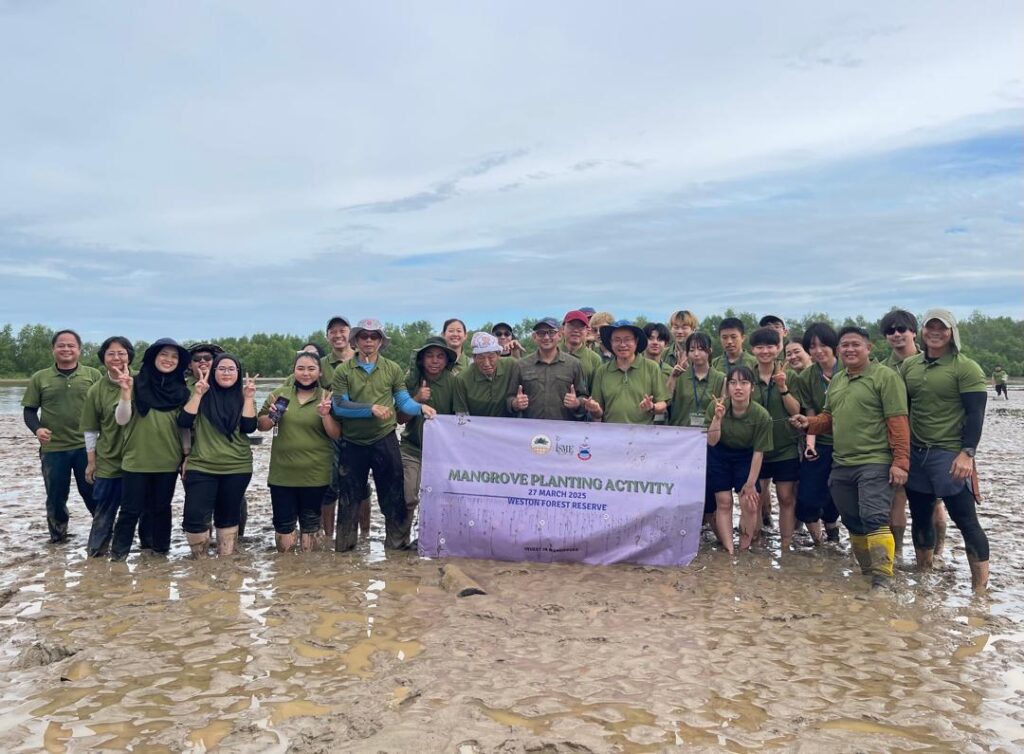
To enhance such effort, a mangrove planting activity organised by the Sabah Forestry Department (SFD), was carried out at the mudflat next to Pulau ISME, adjacent to Weston Forest Reserve on 27th March 2025. Besides SFD, the Natural Resources Office (NRO) of Sabah and International Society for Mangrove Ecosystems (ISME) participated in this event. The Secretary of Natural Resources, Sernam Singh, was the guest of honour, while the Chief Conservator of Forests was represented by his deputy on R&D, Dr Arthur Chung. In addition, a total of 10 students and two teachers from Tokyo Metropolitan Kunitachi Senior High School participated in this activity as part of their study tour to Sabah, led by Emeritus Professor Shigeyuki Baba, the Executive Director of ISME.
This is part of ISME programme to promote the awareness on the importance of mangroves among the younger generation. Some 150 seedlings of Perepat (Sonneratia caseolaris) were planted during this event, which was funded by Tokio Marine and Nichido Fire Insurance Co. Ltd., supported by Sabah Forestry Department.
SFD has been collaborating with ISME since 2010 on mangrove forest management and rehabilitation, now in its 4th phase from 2024 to 2029. ISME is an international non-profit and non-governmental scientific society, with its headquarters in Okinawa, Japan, committed towards sustainable mangrove management and rehabilitation throughout the world. Under the collaboration with ISME, the department’s mangrove rehabilitation programme is undertaken by Dr Joseph Tangah and the mangrove team, based at the Forest Research Centre in Sepilok.