By WU VUIDE
KOTA KINABALU: The Sabah government has launched the Battery Energy Storage System Lahad Datu (BESS Lahad Datu) to reduce power interruptions in the east coast and improve people’s quality of life.
Chief Minister Datuk Seri Hajiji Noor said this comes under the purview of Sabah Electricity to ensure the people continue to enjoy stable, sufficient and affordable electricity supply.
“The success marks an important milestone for Sabah, as BESS Lahad Datu is the largest energy storage facility not only in the country but in South East Asia. It is designed to enhance grid stability, cut dependence on diesel and support renewable energy integration in the state,” he said.
Hajiji said this at the launch officiated by Head of State Tun Musa Aman at the Sabah International Convention Centre.
His speech was delivered by Deputy Chief Minister I and Works and Utility Minister Datuk Seri Dr Joachim Gunsalam.
Hajiji said several strategic steps are being implemented under the Sabah Energy Roadmap and Masterplan 2040 (SERAMP 2040), the main guide for Sabah’s energy direction based on three principles: energy security, cost affordability and environmental sustainability.
“All these initiatives are crucial to ensure socioeconomic progress and the well-being of the people across the state,” he said.
He said the transition of electricity supply and renewable energy regulatory power from the Federal Government to Sabah in January 2024 has enabled the State to frame its own policies and regulations and speed up energy projects tailored to local needs under the supervision of the Energy Commission of Sabah (ECoS).
The Sabah government has also approved nearly 1000 megawatt (MW) of new capacity from various sources including hydro, solar and wind, he said.
To further strengthen power generation, he said ECoS has launched Large Scale Solar (LSS) bids for solar plants from 1 MWac to 15 MWac this year.
From the bids, 15 projects with a combined capacity of 199 MW have been approved, with 113 MW in the west coast and 86 MW in the east coast.
“With the existing projects and those now being implemented, LSS capacity in Sabah is expected to exceed 350 MW by 2027, equal to 23 per cent of the state’s total electricity generation mix,” he said.
Another Large Scale Solar Photovoltaic project in Kota Marudu, expected to be completed by 2026, will further boost Sabah’s energy capacity.
Hajiji said energy storage technology should also be introduced in strategic locations to reduce power interruptions and support renewable energy integration into the main grid.
He said Sabah Electricity is working with the Community Development Leader Unit (UPPM) to carry out initiatives such as the Sabah Renewable Energy Electrification Roadmap (SabahRE2) to widen electricity access in rural and interior areas.
“The Sabah government remains firm in its commitment to improve the reliability, stability and long-term resilience of the state’s electricity system.
“Recognising this as crucial to attracting and sustaining both domestic and international investment, the government, together with Sabah Electricity, ECoS and federal agencies, is dedicated to building a secure, future proof and investor friendly energy ecosystem,” he said.
He also congratulated Sabah Electricity for its success at the Project Management Award 2025 in Kuala Lumpur, where the BESS project won several awards for its high impact in the utility and energy sector.
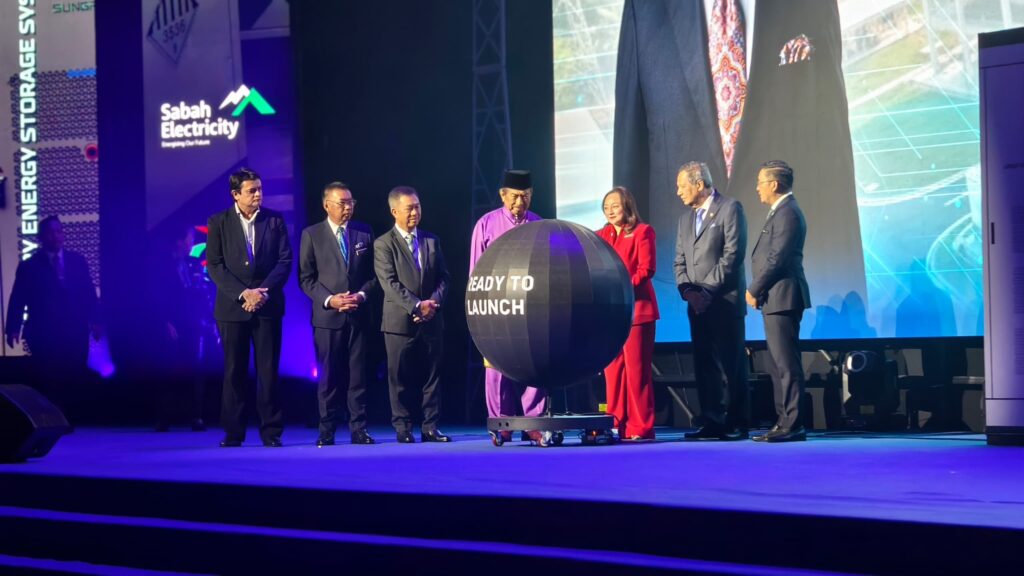
Musa accompanied by Dr Joachim doing the launching gimmick of BESS Lahad Datu.