By WU VUIDE
KOTA KINABALU: Universiti Malaysia Sabah (UMS) is developing microalgae-based technology to support a more sustainable aquaculture industry.
The research focuses on wastewater treatment and the recycling of nutrients and waste resources to improve production efficiency.
The project is led by the UMS Institute for Biotechnology Research (IBR) in collaboration with the Jiangxi Academy of Agricultural Sciences (JxAAS), China.
It has received funding of about RM470,000 under the Jiangxi International Science and Technology Cooperation Programme.
The project will run until November 2028.
The research aims to develop microalgae technology capable of treating aquaculture wastewater.
It also seeks to recover nutrients from waste to improve production efficiency, conserve resources and reduce environmental impact.
IBR director Professor Dr Jualang Azlan Gansau said the research would help develop innovative biotechnology solutions.
He said it also has the potential to strengthen the sustainability of the aquaculture industry.
“This collaboration strengthens knowledge-sharing between researchers in Malaysia and China.
“It also supports human capital development and the creation of technologies that can benefit the aquaculture industry in Malaysia and the region,” he said.
A JxAAS delegation, led by the director of the Institute of Agricultural Product Quality, Safety and Standards Research, Professor Dr Siming Li, visited UMS from July 7 to 10.
The delegation included two senior researchers.
The visit focused on finalising the implementation of the research project.
Jualang said the delegation took part in field sampling and microalgae isolation activities with UMS researchers.
They also held technical discussions on technology development and project implementation.
The delegation visited the UMS Aquarium and Marine Museum.
They also toured the IBR laboratories and hatchery facilities at the Borneo Marine Research Institute (BMRI).
The visit allowed them to assess research facilities supporting the project.
To expand the project’s industry benefits, the delegation also visited the Sabah Fishery and Fishermen’s Development Corporation (Ko-Nelayan).
They explored opportunities for technology transfer, commercialisation of research findings and the application of innovation in the aquaculture sector.
Jualang said the collaboration reflects UMS’ commitment to science- and innovation-based research.
He said the university aims to develop green technology solutions that support a more resilient and sustainable aquaculture industry.
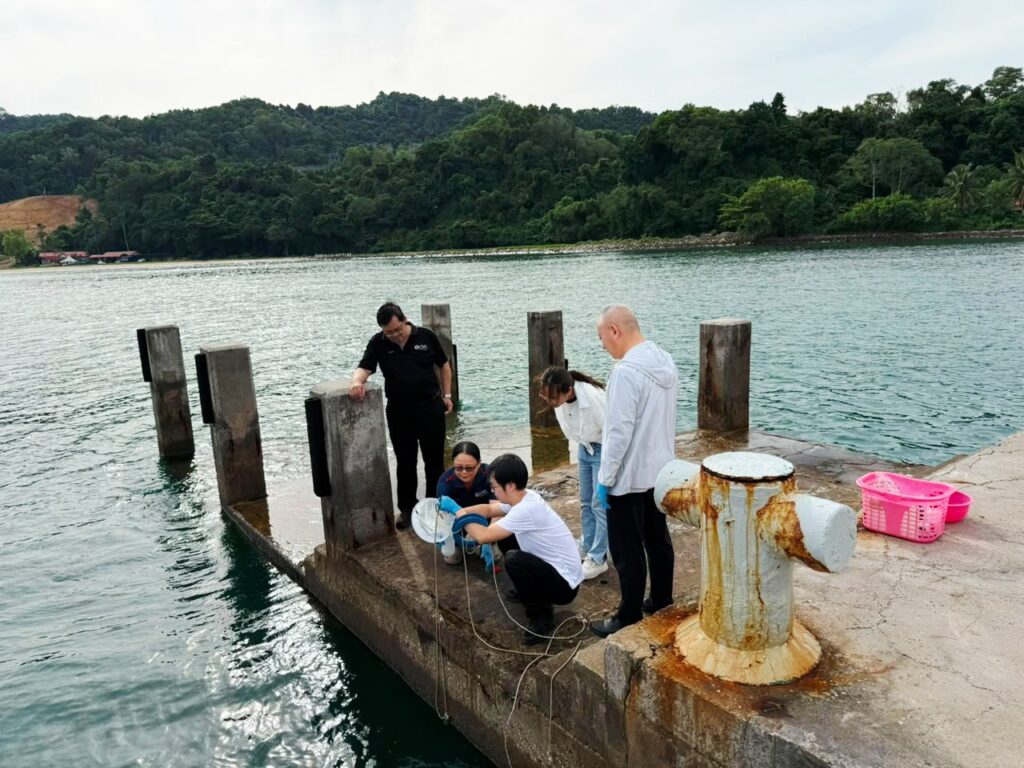
The JxAAS delegation and UMS researchers conduct water sampling to collect baseline data.