KOTA KINABALU: Sabah does not lack development ambitions. We are expanding ports, improving roads, developing industrial parks, strengthening airports, promoting agriculture and tourism, and seeking new investment.
Yet an important question remains: Who is connecting all these pieces into one economic system?
This is why Sabah urgently needs an Integrated Logistics & Transport Masterplan. It should not be another transport study that looks separately at roads, ports, airports, or public transport. It must provide the framework that connects the movement of goods, people, investment, and information across Sabah.
Logistics is the circulatory system of the economy
Almost every economic activity depends upon movement.
Farmers need to move produce to markets. Manufacturers require raw materials and distribution channels. Tourism depends on accessibility. Industrial parks require reliable connections to ports and supply chains. Businesses depend upon timely deliveries, while consumers ultimately bear the cost of inefficient logistics.
When logistics works efficiently, economic activities become easier and more competitive. When it does not, the consequences include higher costs, delays, lost investment, and missed opportunities.
Therefore, transport cannot be viewed merely as infrastructure.
Transport connects places. Logistics connects economic activities. Supply chains connect the economy.
The three must be planned together.
The real problem is fragmentation
One of Sabah’s fundamental challenges is not necessarily a lack of infrastructure, but fragmented planning.
Ports have their development plans. Roads have their programmes. Airports are planned separately. Industrial parks pursue their own infrastructure requirements. Local authorities undertake land-use planning, while logistics facilities develop according to individual commercial opportunities.
Each project may make sense on its own.
But individually sensible projects do not automatically create an efficient logistics system.
A modern port performs worse if cargo leaving its gate faces inadequate road connectivity. An industrial park becomes less attractive if transporting raw materials and finished goods remains expensive. Agricultural production may increase, but farmers gain little if aggregation, cold-chain facilities and market connectivity remain weak.
Worse, solving one bottleneck can simply transfer congestion to another part of the supply chain.
Sabah therefore needs to move from project thinking to system thinking.
One vision, one plan, one network
An integrated logistics & transport masterplan would provide the framework for doing this.
Its philosophy should be straightforward: Rather than treating Sabah as a collection of separate infrastructure projects, the masterplan should examine the State as interconnected economic corridors and supply chains.
Where are our major production centres? Where are the markets? Where does cargo originate and terminate? How should industrial parks connect to ports? Where should logistics hubs, distribution centres and cold-chain facilities be located? What should be the respective roles of Sapangar, Sandakan, Tawau, Lahad Datu and other gateways?
Most importantly: Where are the gaps preventing Sabah’s economy from performing better?
These questions cut across ministries, agencies and industries. No single institution can answer them independently. That is precisely why an integrated masterplan is necessary.
Reducing the economic cost of distance
Sabah’s geography makes logistics particularly important.
Our population and economic activities are dispersed over a large territory. Agricultural production can be far from major consumption centres. Rural communities face connectivity challenges, while the east and west coasts have different economic structures.
We cannot eliminate distance.
But we can reduce the economic cost of distance.
Better freight corridors, cargo consolidation, strategically located logistics hubs, stronger first- and last-mile connectivity and coordination between transport modes can reduce unnecessary movement, delays and costs.
The effect extends beyond transport.
Farmers become more competitive because produce reaches markets faster. An SME gains access to a larger market. Manufacturers operate with greater supply-chain certainty. Investors gain confidence that Sabah can move materials and products efficiently.
Integrated logistics therefore becomes an instrument for both competitiveness and inclusive development.
Investing in the right infrastructure
An integrated masterplan would also help Sabah answer a difficult development question:
What should we build first?
Without an overall framework, projects tend to be evaluated individually. Roads compete with ports, ports with airports, and one district with another.
The better question is: Which investment will remove the most important constraint on economic activity?
Instead of simply building more infrastructure, Sabah can build the right infrastructure, in the right place, at the right time and connected to the right economic activities.
The masterplan can establish immediate priorities, medium-term capacity requirements and long-term strategic investments. This reduces duplication, prevents misaligned investment and allows limited public resources to generate greater economic returns.
Data must connect the system
Integration must also extend beyond physical infrastructure.
Sabah needs a shared logistics and transport data ecosystem covering cargo movements, ports, airports, roads, warehouses, industrial production, agricultural flows and trade.
Without reliable data, planning depends heavily on assumptions.
With shared data, Sabah can identify bottlenecks, forecast demand, measure logistics performance and determine where investment will produce the greatest impact.
A Sabah Logistics and Transport Data Platform should therefore be an integral component of the masterplan.
Ultimately, this is about Sabah’s economy
The strongest case for an Integrated Logistics & Transport Masterplan is not transport itself.
It is economic transformation.
Sabah wants stronger agriculture, competitive industries, successful industrial parks, higher-value tourism, greater investment, stronger rural economies and better employment opportunities. All these ambitions depend, directly or indirectly, upon connectivity and logistics.
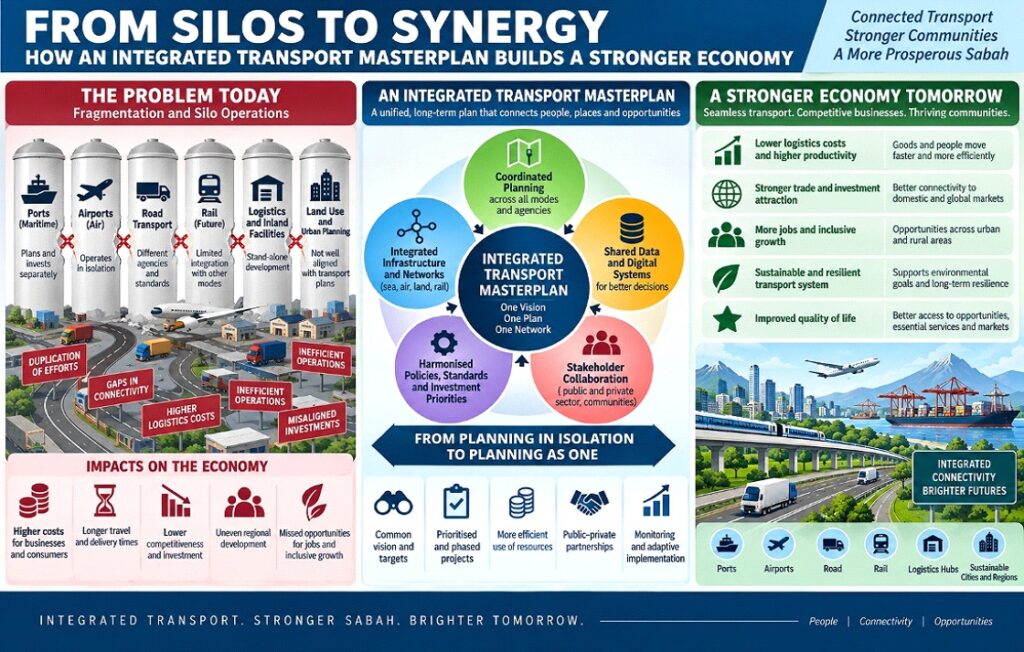
The choice illustrated in the accompanying infographic is straightforward.
We can continue operating in silos—producing duplication, connectivity gaps, inefficient operations, higher logistics costs and misaligned investments.
Or we can integrate—through coordinated planning, shared data, connected infrastructure, common priorities and collaboration between government, industry and communities.
The result would be more than smoother transportation. It would mean lower business costs, stronger trade, greater investment attractiveness, more employment and more balanced development across Sabah.
The masterplan therefore must not become another document sitting on a shelf. It should become the central reference framework against which Sabah’s future transport, logistics and connectivity investments are assessed, prioritised and coordinated.
The question is no longer simply whether Sabah needs another road, port, airport or logistics facility.
The question we should now ask is: How do we make all of them work together as one economic system?
That is the transition Sabah must make—from silos to synergy, projects to networks, and transport planning to economic planning.