By WU VUIDE
KOTA KINABALU: The Bumiputera Economic Agenda must put Sabah and Sarawak at its centre, Deputy Chief Minister III Datuk Ewon Benedick said.
Ewon, who is also Industrial Development, Entrepreneurship and Transport Minister, said policy must reflect the needs of both states.
It must be understood through national unity, the history of Malaysia’s formation, and guarantees in the Federal Constitution.
“The Malaysia Agreement 1963 guarantees protection for the parties that formed Malaysia.
“Article 153 of the Federal Constitution safeguards the interests of Malays and natives of Sabah and Sarawak,” he said at the Bumiputera Economic Congress Engagement Session in Kota Kinabalu.
He said leaders must answer a familiar question: why maintain a distinction between Bumiputera and non-Bumiputera.
“We must return to the foundation on which this country was formed.
“We cannot focus only on Bumiputera in the peninsula. The perspectives, interests and needs of Bumiputera in Sabah and Sarawak must be core,” he said.
Ewon chairs the Sabah Bumiputera Economic Council Steering Committee. He said ministers must serve all ethnic groups, but must also honour existing agreements.
“Our duty is to provide service and leadership to all.
“Because we have an understanding and agreements, we must ensure Bumiputera interests remain part of building a better future,” he said.
While in the Federal Cabinet, Ewon proposed a dedicated cluster on Sabah and Sarawak Bumiputera for the Bumiputera Economic Congress.
“If there was to be substance, there should be a cluster for Sabah and Sarawak.
“That view was recorded in the minutes,” he said.
As a result, the 2024 congress included a Sabah and Sarawak cluster. Panellists included the Kadazandusun Chamber of Commerce and Industry and the Dayak Chamber of Commerce and Industry.
The congress memorandum and resolutions were presented to the Cabinet. They fed into the Bumiputera Economic Transformation Plan 2035.
Ewon said planning must be grounded in Sabah’s data — its poverty levels and the position of micro, small and medium enterprises.
He said he was deeply concerned when Sabah’s poverty was raised in Parliament and Cabinet. Six districts in Sabah are among the 10 poorest in Malaysia.
“We in Sabah need to participate more actively and seriously,” he said. “We have been serious, but it is time to intensify our involvement.”
Ewon said he applied the same approach to the Domestic Look East Policy when he led the Ministry of Entrepreneur Development and Cooperatives.
At the Ministry of Industrial Development, Entrepreneurship and Transport, he said, the focus is creating space for Sabah-based companies to participate.
He said findings from the engagement sessions should be compiled and presented at the Sabah Bumiputera Economic Congress.
The session was organised by TERAJU and the Institute for Development Studies Sabah. The Kota Kinabalu session was the final leg after Kota Marudu, Keningau, Sandakan and Tawau.
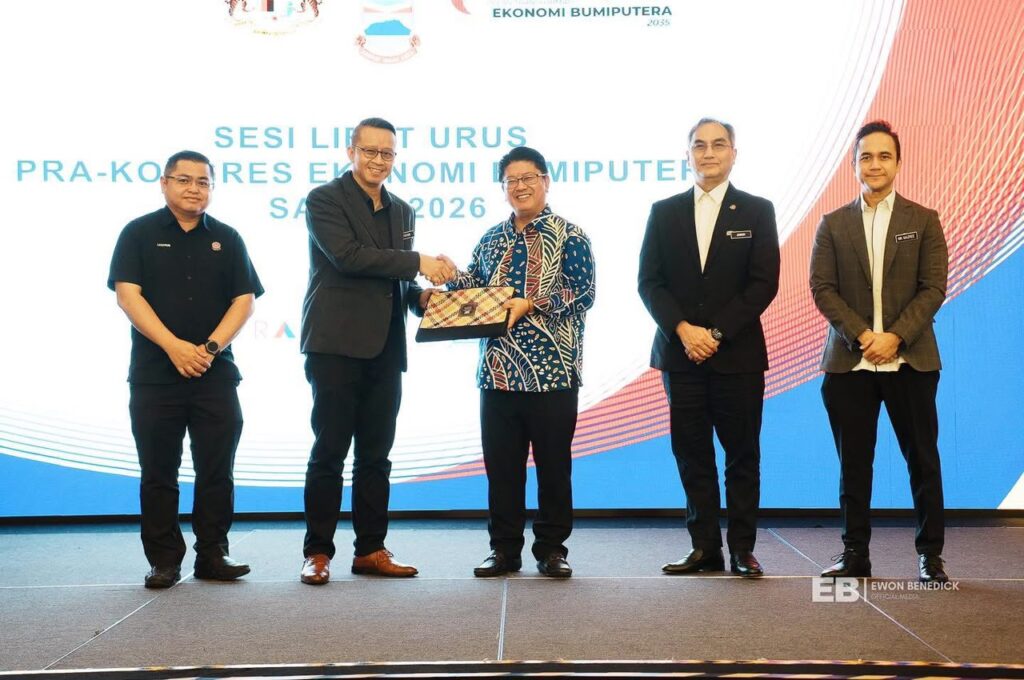
Ewon (centre), receiving a souvenir from acting chief research officer of IDS Sabah Victor Sikain.