By WU VUIDE
SANYA: Tanjung Aru Beach is a world-class tourism asset, yet it is neglected and unfriendly to visitors.
“Our main weakness is the absence of a single authority to manage the beach,” noted Malaysian Association of Tour and Travel Agents (Matta) Sabah Chapter, Chairman Mohd Azlan Saleh Abd Salam.
“If you look at Sanya beach, they have one authority made up of key stakeholders responsible for everything from environmental protection and safety to zoning, facilities, tourism activities and enforcement.
“Every activity is approved, monitored and controlled under one authority,” said Azlan, who was visibly flabbergasted by how Sanya manages its long stretch of beach during a familiarisation trip to Hainan to explore tourism products and attractions in Haikou and Sanya.
He noted that water activities are managed by zones, including surfing, skiing and other recreational uses, each governed by clear standard operating procedures (SOPs).
“The focus is not just on promotion, but on the social impact, safety and sustainability of the destination,” he said.
In Kota Kinabalu, Azlan said the coastline stretches more than 20 kilometres, while Tanjung Aru Beach itself is just over two kilometres long.
“Tanjung Aru Beach is not that long. In fact, it is easier to manage if there is a proper authority in place.
“The problem in Kota Kinabalu is that everyone operates individually.
“Each party has its own idea and its own plan, and there is no single body coordinating everything.
“What we need is one authority to take care of safety, cleanliness, recreation, SOPs and enforcement, one body responsible for the entire coastline,” he said.
In Sanya, electric cars, bicycles, mobility scooters and wheelchairs are commonly used, he noted.
“The beach is designed for everyone, including children, senior citizens and people with disabilities. It is inclusive, friendly and accessible,” he said.
Public awareness, strict SOPs and enforcement are strongly emphasised.
“Littering is fined. CCTV is installed, so people think twice before throwing rubbish. Cleaning is carried out daily,” he observed.
“Here in Kota Kinabalu, even basic enforcement is lacking. There is no clear authority, as illegal stand-up paddleboard operators have mushroomed in recent times,” he said.
Azlan said Tanjung Aru Beach is iconic and historically significant, noting that Queen Elizabeth II once visited the area.
“This is not just any stretch of sand; it is a symbol of Kota Kinabalu and Sabah tourism,” he said.
“Yet today, parts of it have been turned into parking areas. That destroys its beauty. Proper spaces should be created for people to enjoy the sunset.”
He stressed that the government must appoint a single authority to manage the entire coastline, rather than multiple agencies with overlapping roles.
Tourism focus alone is not enough. Conservation, cleanliness, safety and public access must come first, he said.
Azlan said there had been proposals for mega projects, including land reclamation extending two kilometres into the sea, which would have erased the original beach.
“The beach should not be disturbed. It is pristine and must be conserved for wellness, mental health and sustainability,” he said.
Beaches are the reason people come to Sabah, and they should remain open to the public, not fully privatised or fenced off by developments, he said.
“If we are serious about tourism targets, not just four million visitors for 2026, as mentioned by Tourism, Culture and Environment Minister Datuk Jafry Ariffin, but beyond, we need courage, a paradigm shift and drastic improvements.
“This Kota Kinabalu coastline is a major tourism product. If managed properly, it can benefit tourism, the community and public well-being at the same time,” he said.
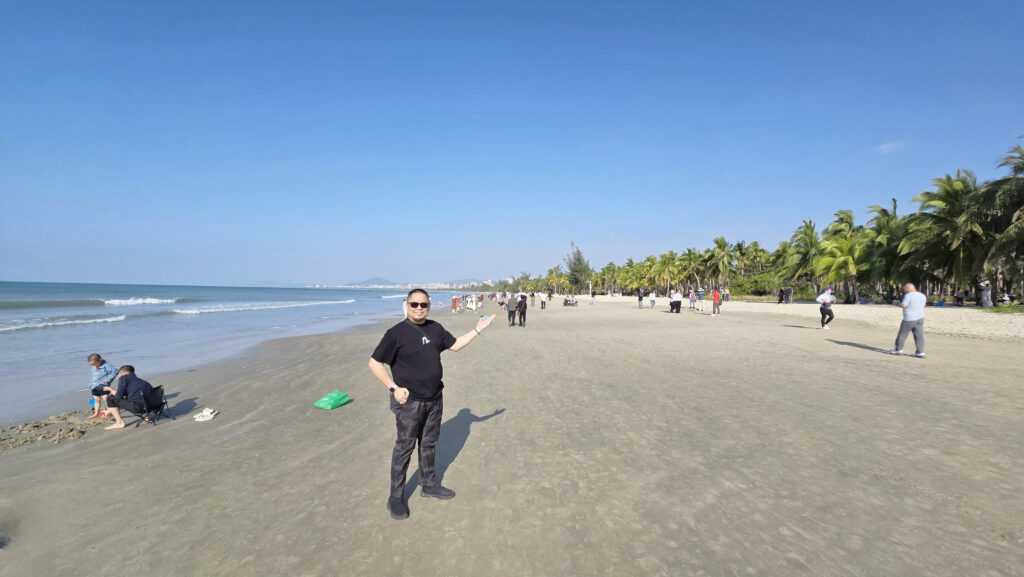
Azlan was flabbergasted by how Sanya manages its long stretch of beach.

The locals and visitors enjoy recreation under the coconut zone.