Story and photos by Paul Mu
muvitet@gmail.com
SAMARKAND was one of the great centres along the Silk Road, where merchants travelled in caravans from China across Central Asia to trade in silk.
Braving deserts and bandits, they passed through Kyrgyzstan, the Fergana Valley, Tashkent, Samarkand, Bukhara and Khiva before reaching the Mediterranean Sea, a journey of about 12,000 km.
Some historians say merchants and traders along the Silk Road spent more than two years in Samarkand for trading, said local tour guide Ibodullayev Bekhrukh, or Bek.
Merchants gathered to trade at the Registan complex, now a tourist attraction known as the “Pearl of the East”.
We visited the Bibi-Khanym Mosque, a 15th-century structure beside a vibrant bazaar selling local goods.
A legend says Bibi-Khanym, one of Timur (also known as Tamerlane)’s wives, built the mosque to honour his return from a campaign in India.
She brought architects and builders from various parts of the world to Samarkand to construct the mosque, but Timur returned unexpectedly from his campaign.
“By then, the work was almost complete but was halted when the chief architect allegedly demanded a kiss from Bibi-Khanym in exchange for completing the project,” said Bek.
She was angry and threatened to punish him, but was told that only he could complete the final stage of the project. With no other option, she allowed him to kiss her cheek through a veil, leaving a faint mark.
When Timur noticed the mark, he said nothing. Instead, he asked her to climb to the top of the gateway and, after saying a few words, pushed her from the structure, said Bek.
Visitors can also view the giant Uthman Quran replica said to have been brought by Timur from Iraq. The original manuscript was once kept within the mosque compound, he said.
It is said that a Russian general later took the original copy to Saint Petersburg, where copies were made and sold. The manuscript has since been returned and is now kept in a library in Tashkent.
The Chinese introduced the traditional method of papermaking through trade, which is still preserved in a village.
We were shown how silk paper is made using mulberry bark, a 2,000-year-old technique that allows the paper to last up to 400 years, he said.
Moving on, our next destination was the remains of the Ulugh Beg Observatory, built by Ulugh Beg, grandson of Timur and a 14th-century Central Asian ruler and astronomer.
Ulugh Beg focused on education and built three madrasahs across his empire — one at Registan in Samarkand, another in Bukhara, and the third in the Fergana Valley in eastern Uzbekistan.
However, he faced opposition over heavy spending, which led to a plot against him, and he was later beheaded in Afghanistan while on his way to Mecca.
Evidence of his beheading was confirmed in 1941 when Russian archaeologists, acting on orders from Soviet leader Joseph Stalin, found his skull placed on his knees.
Archaeologist Mikhail Gerasimov also reconstructed the faces of Timur and Ulugh Beg, he said.
The findings matched historical records, which state that Timur had injuries to his left leg and right hand, and had lost two fingers during a campaign, earning him the nickname “the Lame”.
The great-great-grandson of Timur, Babur, went on to establish his own dynasty in India. A descendant of Babur later built the Taj Mahal.
We visited the Gur-e-Amir Mausoleum, where Timur is buried along with members of his family.
“The main entrance represents the dipping of water, based on an Iranian design. This feature has been preserved since the 14th century and includes a marble bowl,” he said.
The large bowl said to have been used by Timur before battle is still preserved at the site.
“It is said that he ordered it to be filled with water and pomegranate juice for soldiers to drink as psychological preparation for war, symbolically evoking the sight of blood,” he said.
The ceremony is held on a silk carpet-covered platform made from about 60 types of marble sourced from Bukhara, where Timur would sit at the centre, he said.
Bek pointed out a small hole believed to have been used to place his walking stick, as he suffered injuries to his leg and had lost two fingers.
Next, we visited the Shah-i-Zinda complex, a site of ancient mausoleums. It is believed that Qutham ibn Abbas, a cousin of the Prophet Muhammad, came to Samarkand in the 7th century to spread Islam.
However, according to tradition, he was later killed during conflicts with early local communities.
Bukhara is one of the oldest cities in Central Asia, founded around 500 BC, and is located about two hours away by high-speed Afrosiyob train.
Bukhara is regarded as a holy place for Muslims and was also a centre of Buddhism before the arrival of Islam in the 8th century, said local tour guide Ali.
The city lies on the ancient Silk Road linking China and Central Asia.
The people of Bukhara adopted Persian culture, especially its architecture. It is also known for handmade silk carpets and textiles, he said.
During ancient times, silk was extremely valuable — about one kilogram of silk could be equal in value to one kilogram of gold. If a king brought silk, it was considered a highly valuable gift.
Bukhara silk is considered among the best in the world, especially its carpets, embroidery and silk products such as shawls.
There are special schools where young people learn carpet-making.
We visited the Bukhara Silk Carpet School, where girls start learning from around 12 years old.
“A single one-metre carpet can take about nine months to make. Some take a year, with only about 10 cm produced in many hours of work,” he said.
Silk was brought from China to Bukhara, where conditions were suitable for production.
Designs are colourful and often inspired by fruit and nature. Knife-making is also famous here, as well as jewellery, he said.
Many famous figures were born in Bukhara, including Imam al-Bukhari, who compiled one of the most important books of Hadith.
He later died in Samarkand, where we visited his mausoleum under the guidance of an imam who led prayers there.
The city is also known for its fruits, including apples, pomegranates, watermelons and apricots.
Prices are cheaper compared with other places. Bukhara is mainly an agricultural city, and many of its products are sent to Tashkent.
The old city of Bukhara also features the Po-i-Kalyan complex, home to the Kalyan Minaret and mosque, as well as the Ark Citadel, a massive fortress representing the city’s royal history.
Every year, it is said that the King of Dubai comes to Bukhara to hunt falcons in the desert, as the bird is found in Bukhara, Pakistan and Morocco.
During winter, hunters also come to collect them or their eggs. The price of a falcon egg can reach about US$5,000.
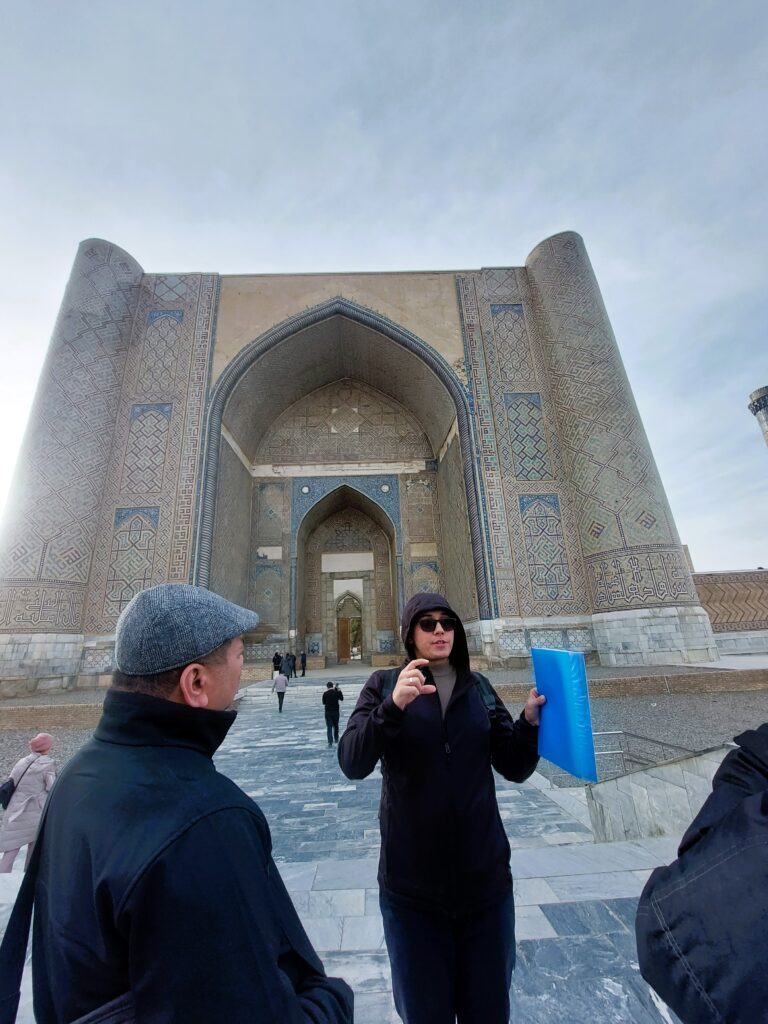
Bek explaining the fascinating tales of the Bibi Khanym Mosque.