TELUPID: The increasing frequency of Bornean pygmy elephant incursions into residential areas and public facilities in Telupid has raised safety concerns.
Although videos of elephants roaming near the local health clinic, schools and other public facilities have recently gone viral, the problem has persisted for more than a decade, with sightings becoming increasingly frequent this year.
Forever Sabah Human-Elephant Harmony Project coordinator Alvein Dee Albenus said the increase could be linked to ongoing Pan Borneo Highway construction through the Tawai Forest Reserve, which cuts across traditional elephant feeding grounds and movement routes.
He said forest clearing had intensified last year, while construction activities extending into the night could further disturb the animals and force them into nearby settlements.
Alvein warned that the highway could increase the risk of accidents involving elephants and motorists if adequate wildlife crossings were not provided.
The incursions, initially reported in Kampung Liningkung, Kampung Gambaron and Kampung Bauto, have since spread to other settlements and areas near SMK Telupid, the police station, health clinic and government offices.
Residents have reported damage to property and crops, while some fear for their children’s safety when travelling to and from school.
Alvein advised villagers against planting crops that attract elephants, including banana, coconut, areca nut and cempedak, near their homes. He also cited declining food sources in the forest reserve and expanding agricultural plantations as contributing factors.
The project estimates that more than 200 elephants inhabit the Tawai Forest Reserve area, although the exact population remains unknown.
Alvein said his five-member field team, supported by Sabah Wildlife Department personnel and community rangers, have been working almost daily to guide elephants back into the forest.
However, managing the animals remains challenging when they split into smaller groups and enter different locations simultaneously.
He stressed that the issue was not only about protecting wildlife but also ensuring public safety, calling for better measures to manage human-elephant conflicts and provide safe movement corridors for the animals.
The Bornean pygmy elephant is classified as endangered on the International Union for Conservation of Nature Red List, with an estimated 1,000 remaining in the wild, including about 400 breeding adults. – James Leong
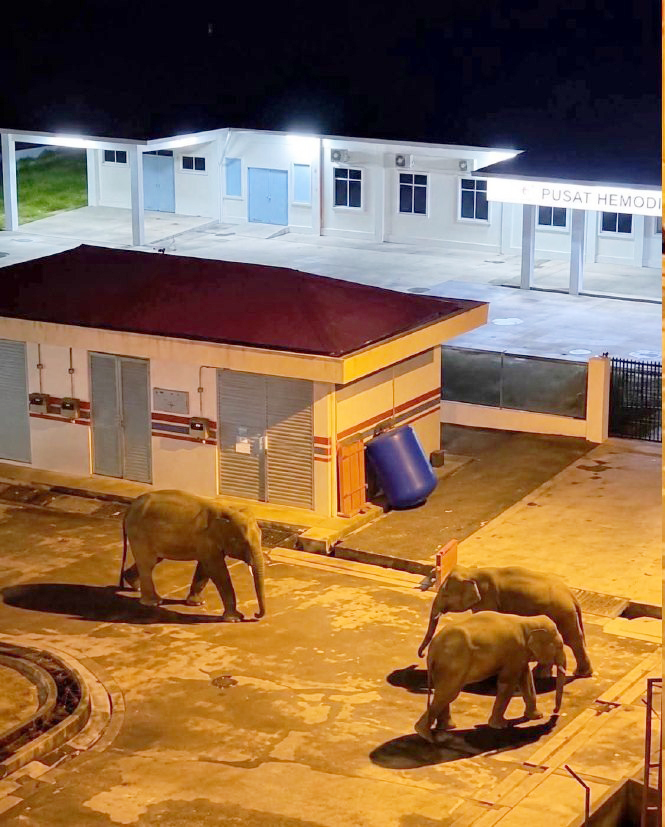
Bornean pygmy elephants entering the compound of Telupid Health Clinic – (photo credit – social media).