By WU VUIDE
KOTA KINABALU: A Japanese airbrush artist has developed a fascination with Sabah’s cultural diversity and wildlife, which has drawn him back to explore further.
Yasuaki Takahashi, from Tottori in southern Honshu, Japan’s main island, first visited Kota Kinabalu for a holiday and was inspired to document its people and culture through art.
His dream was realised when he was invited to produce a large airbrush artwork depicting the faces of staff members at Mari Mari Cultural Village. The artwork is now displayed at the entrance and behind the main stage at the centre.
This was made possible after he was introduced to Mari Mari Cultural Village creative director and artisan mentor Yumiko Ueno, who arranged the project.
Yasuaki later expressed his intention to conduct art workshops for schoolchildren, similar to those he regularly carries out in Japan to help students discover their artistic potential.
Yumiko said they obtained approval from the State Education Department to conduct a session at SM Mutiara Kota Kinabalu, with full support from the school principal.
In Japan, she said Yasuaki is known for his airbrush portraits of well-known figures, including the Japanese Prime Minister and international artistes such as Beyoncé.
Yumiko said Yasuaki now hopes to document indigenous communities in Sabah, including the Murut and Lundayeh, through airbrush art.
He also plans to portray the Bobohizan, the Kadazan Dusun high priestess, and has met one of the remaining practitioners.
She said the aim is to help preserve cultural heritage as the number of Bobohizan practitioners continues to decline.
“Painting the Bobohizan by hand using airbrush techniques brings warmth to the work. It reflects the artist’s heart and passion,” Yumiko said.
She said the initiative is driven purely by passion, as Yasuaki believes art can serve as a lasting record and help younger generations appreciate traditional practices.
Yasuaki has also travelled to Sandakan to observe insects and wildlife, including snakes and frogs, which are among his favourite subjects.
He said he hopes to inspire underprivileged children to unearth their hidden drawing talents.
One of his most satisfying moments was during a visit to a slum area in the Philippines, where he deliberately drew on discarded paper.
The simple act attracted children’s curiosity and one of them went on to produce an artwork that was later sold to the local authority.
The proceeds were donated to the children, who used the money to buy rice for their families.
“The message he wants to share is that waste can be transformed into something meaningful, and that every child has potential if given guidance,” Yumiko said.
Yasuaki believes every child possesses individual strengths and only needs guidance and skills to hone them.
Speaking through translator Gai Ueno Dares, Yasuaki encouraged pupils to improve by appreciating the strengths in others’ work rather than focusing solely on their own.
He said artistic growth occurs faster when individuals recognise positive qualities in their peers’ artwork.
“If you can find something good in your friend’s art, your own skills will improve more quickly,” he said.
Yasuaki also addressed concerns about pursuing art as a career due to financial uncertainty.
He said artists who wish to earn a living must understand clients’ needs.
“Passion is crucial to sustaining an artistic career, and artists must be able to communicate meaning through their work,” he said.
Yasuaki said he does not limit himself to a single genre and produces work based on what viewers or clients request.
“Understanding what people want is important if you want to make a living through art,” he said.
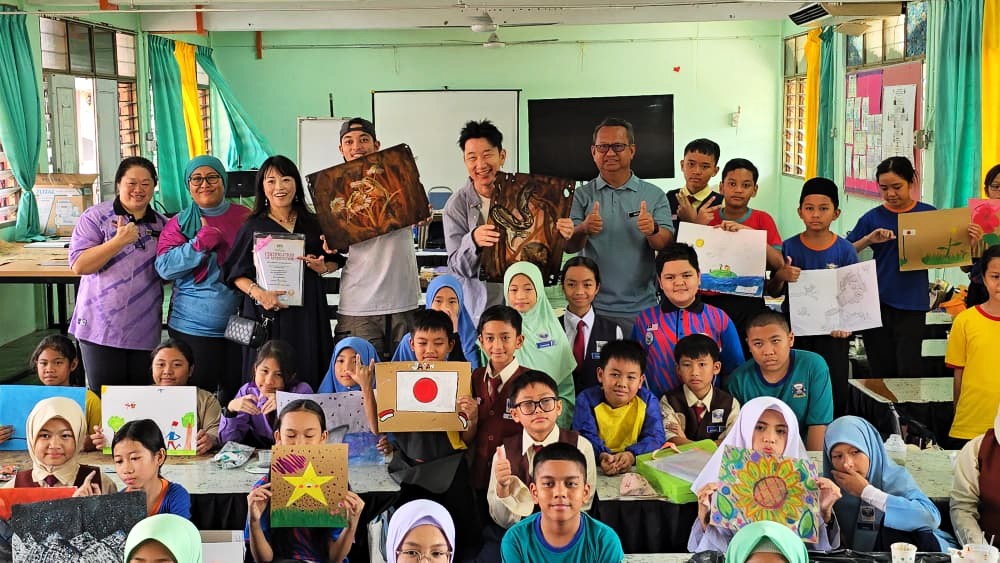
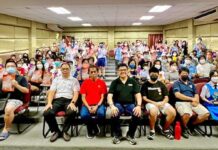
Yumiko, Gai and Yasuaki (third to fifth from left), with teachers and pupils of SK Mutiara Kota Kinabalu after the art activity.