By WU VUIDE
KOTA KINABALU: The government and the public must work together to support the tourism industry, said Deputy Agriculture and Food Security Minister Datuk Chan Foong Hin
He said tourism was a unique industry whose success depended on support from various sectors and stakeholders.
“Although tourism is not directly under my portfolio, I would like to emphasise that tourism is a very unique industry,” he said during the Star Karnival Cuti-Cuti Malaysia (SKCCM) from Aug 14 to 16 at Imago shopping mall.
The carnival themed “Explore, Experience, Excite”, aims to encourage Malaysians to discover domestic destinations, while supporting local tourism businesses.
The three-day carnival features tourism products, travel promotions, stage performances, interactive activities and lucky draws.
The carnival is being held in six states, starting in Pahang and Johor before coming to Sabah, then continuing to Penang, Selangor and Sarawak.
The nationwide series targets more than 200,000 visitors and over RM1 million in sales, while providing tourism industry players with a platform to engage directly with consumers.
Chan said the agriculture and food sectors, for example, played an important role in supporting tourism by ensuring sufficient and attractive food offerings for visitors.
He said issues affecting other sectors, such as water supply disruptions, could also have a direct impact on tourists’ overall experience.
“This shows that tourism involves many different stakeholders and sectors,” he said.
Chan said the government must therefore work together to achieve Malaysia’s tourism goals, while the public and private sector also had important roles to play.
He said media organisations also had an important role to play by promoting destinations, activities and tourism products.
“Collaboration between the media, government and tourism industry players is very important,” he said.
Chan also highlighted several tourism attractions in Sabah, including the KK Hop-On Hop-Off service and Desa Dairy Farm in Kundasang.
Chan was also impressed by Taun Gusi village homestay in Kota Belud whose tourism product had been recognised under the ASEAN Community-Based Tourism Awards.
Chan said the operator told him that most of its clients came from Europe.
“I jokingly asked him: if most of your customers are European, perhaps you should be selling your packages in euros instead of only earning in Malaysian ringgit,” he said.
Chan said the exchange demonstrated the potential of Sabah’s tourism industry to attract international visitors.
“We have many unique tourism products, and with the right promotion, collaboration and support, we can attract more international and domestic visitors,” he said.
According to the Sabah Tourism Board, 2.3 million domestic visitor arrivals in 2025 reflects the state’s continued appeal among Malaysian travellers and supporting preparations for Visit Malaysia 2026-2027 and Visit Sabah 2027.
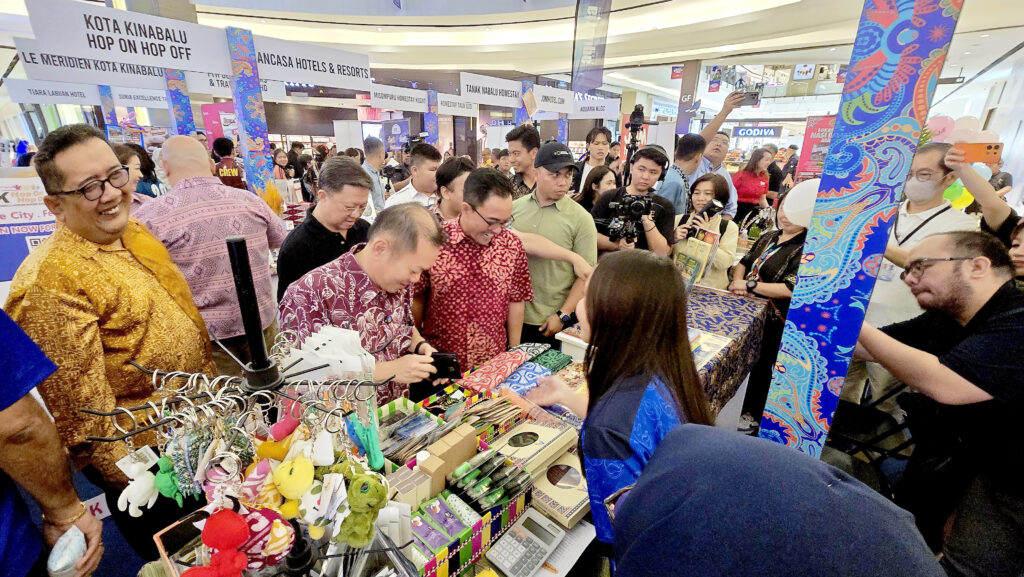
Chan (second, left), visits a booth and buys an item.