SANDAKAN: In a landmark study published in the journal Animal Biotelemetry, an international team of researchers has uncovered unprecedented insights into the spatial behaviour and movement patterns of the Sunda clouded leopard (Neofelis diardi).
Combining high-resolution GPS telemetry with long-term camera-trap surveys, the research offers the first fine-scale look at how this elusive, threatened apex predator navigates a highly fragmented, human-modified landscape in the Lower Kinabatangan floodplain of Sabah, Malaysian Borneo.
The study monitored wild clouded leopards navigating a 2,000 km² mosaic of protected riparian forests, commercial reserves, and sprawling commercial oil palm plantations.
“We found that tracked adult males maintained home ranges of approximately 41 km², whereas an adult female occupied a significantly smaller, concentrated range of around 7 km²,” said Dr Andrew Hearn from WildCRU and first author of the paper.
“In terms of territorial partitioning, male clouded leopards showed strong spatial segregation with minimal territory overlap (roughly 8%), suggesting strict boundary enforcement. Conversely, the females’ range overlapped substantially with multiple males,” he added.
When it comes to forest reliance, clouded leopards rely almost exclusively on native forests for resting and stationary periods (98%–100%). While individuals occasionally traversed oil palm plantations and crossed roads, they moved nearly twice as fast through these open areas (up to 1.49 km/h) compared to inside natural forests (0.37–0.53 km/h)—treating agricultural areas as high-risk transit zones rather than viable habitats.
The study also showed that the species exhibited cathemeral behaviour (active during both day and night), with prominent activity peaks at dawn and dusk.
“We also identified critical topographies that act as social ‘communication hubs’. A single, isolated limestone ridge measuring just 200 meters long—the Batangan Ridge—accounted for over 54% of all camera-trap detections across the entire 2,000 km² study area,” concluded Hearn.
While most forest detections were solitary, this isolated ridge saw frequent visits from multiple individuals, overlapping male territories, and the vast majority of observed scent-marking behaviours—highlighting the disproportionate ecological importance of unique landscape features for species communication.
The study’s findings challenge previous broad spatial models that artificially inflated clouded leopard home ranges into agricultural areas, proving that oil palm landscapes serve merely as temporary conduits.
“Our findings clearly demonstrate that while Sunda clouded leopards can cross human-modified habitats, their survival fundamentally depends on intact, connected forest networks,” said Dr Benoit Goossens, Director of Danau Girang Field Centre and Professor at Cardiff University, who is one of the lead authors.
“Protecting natural forest patches, riparian corridors, and distinct features like ridgelines is non-negotiable if we want to maintain landscape connectivity and social stability for this species,” he added.
“The study echoes an urgent call for land managers and policymakers in Sabah and across Southeast Asia to prioritise the protection and restoration of forest corridors within agricultural landscapes,” concluded Goossens.

A Sunda clouded leopard in Kinabatangan is captured on this camera trap. — Photo courtesy of Danau Girang Field Centre
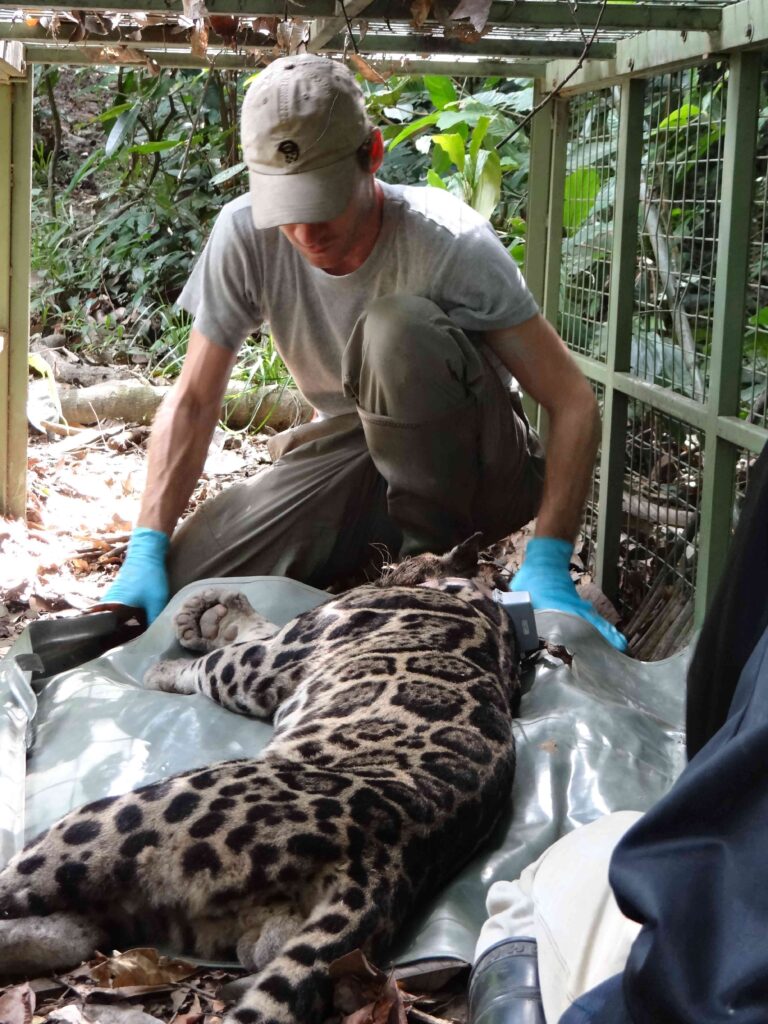
Dr Andrew Hearn, lead author of this study, with one of the collared males during its recovery and before its release. – Photo courtesy of Danau Girang Field Centre