Fragmented logistics, fragmented economy
KOTA KINABALU: An economy cannot function as one integrated system when the networks that connect it continue to operate in separate pieces.
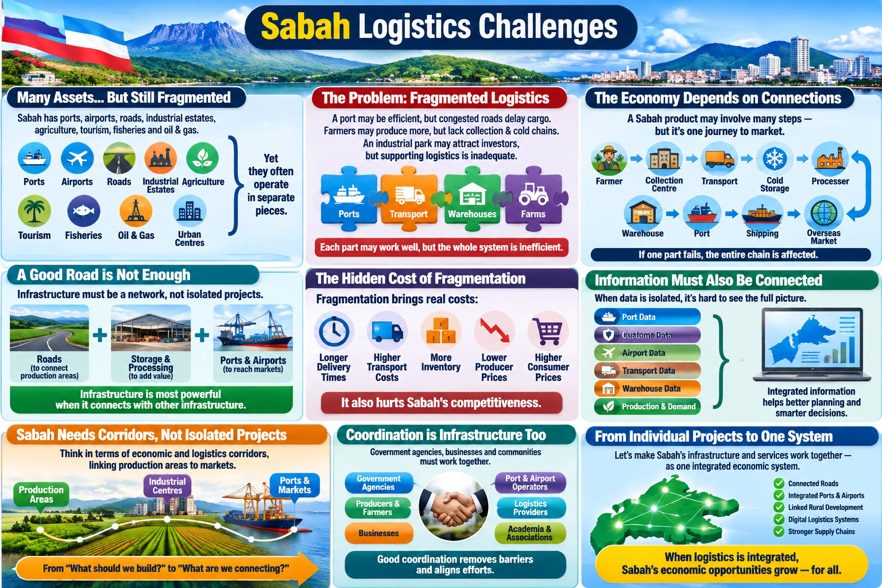
Sabah does not lack economic assets. We have ports, airports, roads, industrial estates, agricultural production areas, tourism destinations, fisheries, oil and gas activities and growing urban centres.
Yet possessing all these components does not necessarily mean they function as one economic system.
A port may operate efficiently, but if the roads serving it are congested, cargo is still delayed. Farmers may increase production, but without collection centres, cold chains and reliable transport, access to markets remains limited. An industrial park may attract investors, but its competitiveness suffers if supporting logistics services are inadequate.
Each component may work reasonably well on its own while the overall system remains inefficient.
This is the problem of fragmented logistics — and when logistics is fragmented, the economy itself risks becoming fragmented.
The economy depends on connections
We often plan economic development by sector.
Agriculture has its programmes. Tourism has its plans. Industrial development has its strategies. Ports, airports and roads may be administered by different authorities. Rural development, trade facilitation and digitalisation may each fall under different institutions.
There are good administrative reasons for such divisions.
But businesses and supply chains do not operate according to government organisational charts.
A Sabah agricultural product moving to an overseas consumer may involve a farmer, collection centre, transporter, cold-storage operator, processor, warehouse, port, shipping line, customs authority and overseas distributor.
To the product, these are not separate sectors.
They are one journey.
If one part fails, the performance of the whole supply chain is affected.
A good road is not enough
This is why infrastructure development should increasingly be viewed as a network rather than as a collection of individual projects.
Consider a new road connecting an agricultural area.
The road may significantly reduce travelling time. But its full economic benefit will not be realised if farmers still lack aggregation facilities, refrigerated storage, processing capacity or reliable transport services.
Similarly, expanding a port can increase handling capacity. But if the surrounding road network, container depots, warehouses and cargo-clearance systems cannot handle the additional volume efficiently, congestion simply moves from one part of the supply chain to another.
The same principle applies to airports.
More terminal capacity may accommodate passengers, but tourism growth also depends on ground transportation, accommodation, destination accessibility and connections between the airport and surrounding economic activities.
The lesson is simple:
Infrastructure becomes economically powerful when it connects with other infrastructure.
The hidden cost of fragmentation
Fragmentation carries costs, although they may not always be immediately visible.
Businesses hold additional inventory because delivery times are uncertain. Trucks wait unnecessarily because schedules are poorly coordinated. Containers remain longer than necessary because information does not move quickly enough. Farmers receive lower prices because they cannot aggregate sufficient volumes to reach larger markets.
These inefficiencies accumulate.
Individually, each may appear relatively small. Across thousands of transactions, however, they become part of the cost structure of Sabah’s economy.
Eventually someone pays.
Businesses absorb some costs through lower margins. Producers may receive less for their goods. Consumers may pay higher prices. Investors may choose locations where supply chains are easier to manage.
Fragmented logistics therefore becomes more than an operational inconvenience.
It becomes an economic competitiveness issue.
Information can also be fragmented
Modern logistics is not only about physical movement. Information must move alongside cargo.
Ports know what is moving through their terminals. Customs has trade information. Airports hold cargo and passenger data. Transport operators understand vehicle movements. Warehouses know inventory patterns, while producers and manufacturers have information about production and demand.
When these datasets remain isolated, it becomes difficult to see the complete picture.
How much cargo is moving between particular districts? Where are the bottlenecks? Which commodities require better cold-chain facilities? Where should future warehouses or distribution centres be located?
Without integrated information, planning can become reactive rather than anticipatory.
Sabah therefore needs not only connected physical infrastructure but increasingly connected information infrastructure.
Data can help transform separate logistics activities into a visible economic system.
Sabah needs corridors, not isolated projects
One way of overcoming fragmentation is to think increasingly in terms of economic and logistics corridors.
Instead of considering a port simply as a port, we should examine the entire corridor connecting production areas, industrial centres, roads, warehouses and markets to that port.
Instead of considering rural roads individually, we should ask what supply chains they support and where the goods travelling on them eventually need to go.
This changes infrastructure planning from:
“What should we build?” to “What economic activity are we trying to connect?”
That is a much more powerful development question.
It encourages infrastructure investment to follow economic flows rather than administrative boundaries.
Coordination is infrastructure too
There is another form of infrastructure that cannot be built from concrete or steel.
It is institutional coordination.
Government agencies, port and airport operators, logistics companies, producers, manufacturers, universities and business associations each hold part of the solution.
No single institution controls the entire supply chain.
That means integration requires a mechanism through which different stakeholders can identify common problems, share information and coordinate solutions.
This does not mean creating another layer of bureaucracy. Quite the opposite.
Good coordination should remove unnecessary barriers between existing institutions and help them work towards common economic objectives.
Sometimes the most important infrastructure is simply getting the right people, information and decisions connected.
From individual projects to one system
Sabah’s development challenge is therefore not merely to build more infrastructure.
It is to make existing and future infrastructure work together.
Roads must connect production areas to markets. Ports must connect with industrial development. Airports must connect with tourism and high-value supply chains. Rural development must connect with collection, processing and distribution. Digital systems must connect information across these activities.
The economy does not experience these as separate ministries, agencies or projects.
It experiences them as a supply chain.
That is why logistics offers such a useful lens through which to view Sabah’s development.
It forces us to see connections rather than components.
A fragmented logistics system produces unnecessary distance, cost and delay. An integrated logistics system allows resources, businesses and communities to participate more effectively in the wider economy.
Sabah already possesses many of the pieces.
The next challenge is to make those pieces function as one connected economic system.
Because ultimately, when logistics remains fragmented, economic opportunity becomes fragmented too.