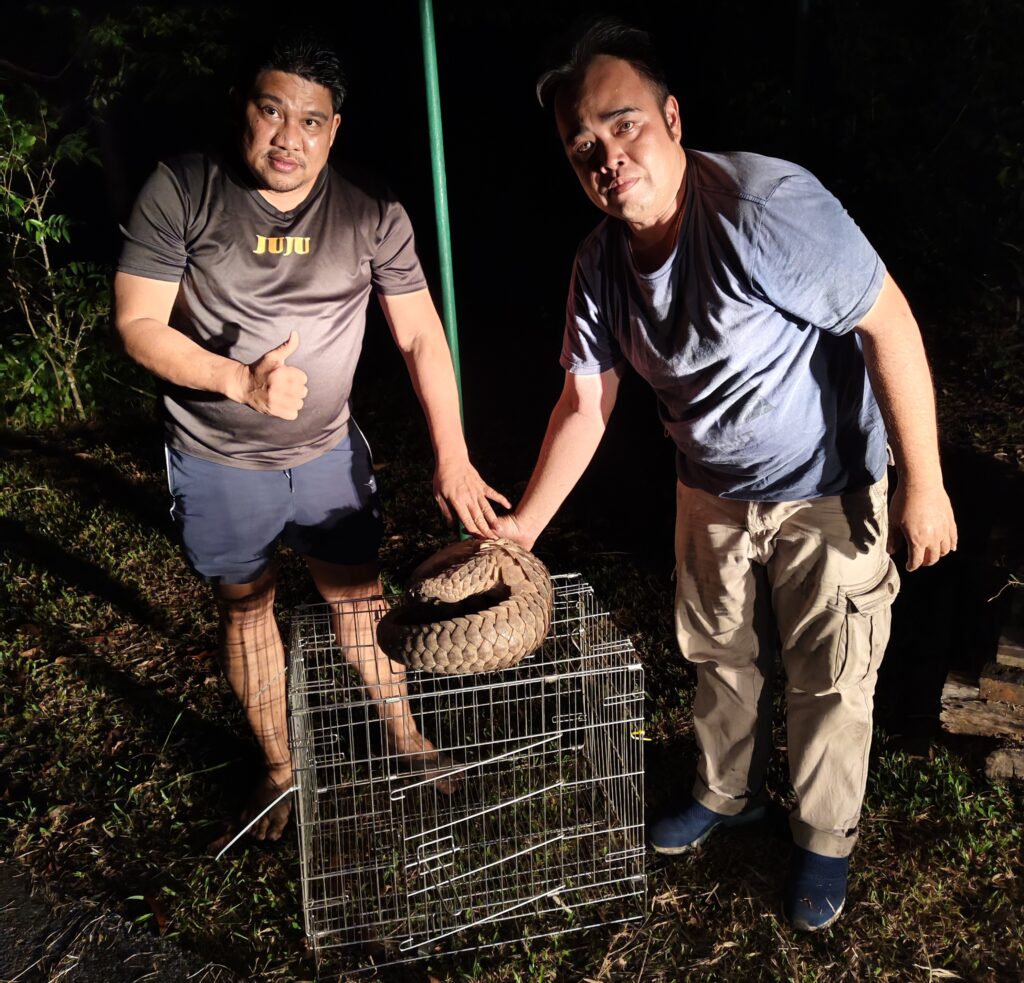
SANDAKAN: A local mechanic’s quick thinking and compassion led to the rescue and safe release of a critically endangered Sunda pangolin near his workshop in Ming Huat Industrial Estate, Mile 3 Jalan Utara on Thursday.
The incident unfolded around 8:00 pm when Benjamin Chin (Ben), working a night shift, was alerted by his dog’s incessant barking. Investigating the noise, Ben and a worker discovered a pangolin hiding beneath a wooden rack.
“I noticed injury marks on the pangolin,” Ben, 41, said. Concerned for its well-being, he initially planned to release it but sought advice from a friend at the Sabah Forestry Department. Following the recommendation, Ben and his friend decided to return the mammal to its natural habitat.
Acting swiftly, they transported the pangolin to a forest nearby. In a poignant moment, the mammal shed tears as Ben lifted it from the cage— possibly a sign of distress or uncertainty.
Once placed on the ground, the pangolin which weighed about 10 kilogrammes, cautiously moved toward the forest, climbed a tree and came back down, before it eventually disappeared into the woods. The entire rescue mission concluded by 11.00pm.
The Sunda pangolin, Malaysia’s only native pangolin species, is classified as Critically Endangered by the International Union for Conservation of Nature (IUCN). Despite legal protections, it remains the world’s most trafficked non-human mammal, heavily poached for its scales, which are falsely believed to have medicinal properties in Traditional Chinese Medicine.
All pangolin species are fully protected. In Sabah, the Sunda pangolin is listed in Part 1 of Schedule 2 of the State Wildlife Conservation Enactment 1997, meaning any hunting requires a license. Hunting without a license can bring a maximum penalty of five years in jail, a fine of up to RM50,000 or both.
The biggest threat facing pangolins in Sabah is illegal hunting for international trade, involving live animals, meat and scales, while another threat is habitat loss and fragmentation – although the severity of this threat requires further research in Sabah.
Ben’s actions highlight the importance of public awareness and swift intervention in safeguarding endangered wildlife. Authorities urge anyone who encounters protected species to report them to the Sabah Wildlife Department or relevant agencies. – James Leong