KOTA KINABALU: For too long, Sabah’s economic story has been a tale of magnificent potential perpetually undermined by a peculiar form of self-sabotage: governmental fragmentation. We built islands of ambition—a gleaming industrial park here, a deep-water port there, a well-intentioned entrepreneur programme somewhere else—but failed to build the bridges between them. The result was an economy running on one cylinder, its inherent strengths neutralised by a lack of orchestration. The relentless recitation of our “resource-rich” and “strategically located” status began to sound less like a statement of fact and more like a lament for what could have been.
This is why the creation of the Ministry of Industry, Entrepreneurship and Transport is an event that demands scrutiny beyond the usual political pageantry. It is not a mere reshuffle of portfolios; it is a profound, if belated, institutional confession. The state government has formally acknowledged that the siloed model of governance—where industry, business, and transport lived in separate bureaucratic universes—has been a primary cause of our stunted development. In response, it has engineered a deliberate collision of these domains under one roof, led by Deputy Chief Minister III Datuk Ewon Benedick. This is the vehicle for integration we have long needed. The monumental question now is whether we have the driver, the map, and the will for the arduous journey ahead.
The high cost of fragmentation: A legacy of missed connections
The evidence of our disjointed past is etched into our economic landscape. Consider the paradox of the Palm Oil Industrial Cluster (POIC) in Lahad Datu. Conceived as a world-class downstream hub, its potential has been consistently undercut by logistical constraints. The roads connecting it to its hinterlands and sister zones were not planned as part of its operational DNA; they were afterthoughts, perennially playing catch-up. Meanwhile, the Sapangar Bay Container Port (SBCP) has spent years seeking the critical cargo volume to justify its hub aspirations, while just inland, businesses struggled with the cost and complexity of using it.
This was no accident. It was the inevitable output of a system where the Economic Planning Unit charted a course, the Industrial Development Ministry worked on sites, the SME agency ran its programmes, and the Works Department built roads based on political and engineering imperatives, not integrated economic logic.
Each entity could claim success in its narrow key performance indicator—a factory built, a road kilometre paved, a loan disbursed—while the overall economy failed to ignite. We mastered the art of building things, but lost sight of building systems.
The new ministry represents a radical shift towards systems thinking. It is an explicit recognition that in today’s global economy, competitiveness is determined by seamless ecosystems. A port is not just infrastructure; it is the sharp end of your industrial and trade policy. A highway is not just asphalt; it is a determinant of where investment will flow and whether a rural entrepreneur can compete. By fusing these portfolios, Sabah has finally created a command centre where these decisions can be made in concert, not in conflict.
The crucible of execution: Where slogans meet the hard ground
Of course, architectural brilliance on an organisational chart guarantees nothing. The true test of this “strategic inflexion point” lies in the gritty, unglamorous arena of execution. Sabah has assets: KKIP’s established base, POIC’s specialised focus, SOGIP’s energy linkages, and a burgeoning SME sector. The ministry’s mandate is to weave these into a cohesive industrial fabric, not merely manage them as disconnected properties.
This requires a fundamental rethinking of priorities. For instance, the upcoming Sabah Total Transport Masterplan must be a revolutionary document. It cannot be another wish-list of routes dreamed up by engineers in isolation. It must be an economic manifesto in concrete and steel, answering brutal, strategic questions: Which existing industrial cluster gets priority freight corridor upgrades to slash its logistics costs? Which agricultural district will be connected to a planned agro-processing park via a dedicated farm-to-port road network? The plan must make winners and losers based on cold, economic potential, not political favouritism. Its credibility will be its first and greatest test.
Similarly, the “Sabah First” agenda, now housed within this powerful ministry, must evolve from a feel-good slogan into a ruthless engine of local capital formation and value capture. This means moving beyond grants and training modules. It demands that the ministry use its consolidated authority to dismantle the Kafkaesque red tape that stifles local businesses. It requires actively brokering supply-chain marriages between anchor tenants in KKIP or POIC and capable Sabah-owned MSMEs. Success should be measured not by the number of certificates awarded, but by the rising share of local content in Sabah’s exports and the growth of mid-sized Sabah firms that become regional players in their own right.
The perils of centralisation: From powerhouse to bottleneck
We must also voice the critical caveat. Consolidating power does not inherently guarantee wise decisions; it can simply concentrate the capacity for error. A super-ministry risks becoming a super-bottleneck if old bureaucratic mentalities persist behind the new facade. If the culture remains one of top-down directive rather than facilitative partnership, if stakeholder engagement is limited to ceremonial consultations, then the new structure will merely have replaced three small problems with one colossal one.
Therefore, the ministry’s internal culture is as important as its mandate. It must foster a new breed of civil servant—systems thinkers who understand the interplay between logistics tariffs and factory profitability, between broadband connectivity and entrepreneurship. It must develop integrated key performance indicators that reflect ecosystem health, such as “average domestic value-added per export container” or “reduction in inland logistics costs for MSMEs.”
Furthermore, this experiment requires a shield of unwavering, cross-party political will. The benefits of integrated planning are long-term, but political cycles are short. The ministry’s strategies will face intense pressure to deliver quick, visible wins, which could distort priorities away from foundational, system-building work. Sabah’s political leadership must provide the air cover for the ministry to execute a decade-long plan, defending it from the centrifugal forces of parochialism and short-termism.
A moment of unprecedented convergence
History has presented Sabah with a rare and fleeting moment of convergence. Economic indicators are strong. Investor interest in Southeast Asia is high. Our geographic position in BIMP-EAGA is more relevant than ever in an era of supply-chain diversification. And now, we have constructed the institutional machinery to harness these forces.
This is our inflexion point. If we succeed—if this ministry becomes the engine of genuine integration, breaking down walls both within government and between the economy’s sectors—it will be remembered as the turning point where Sabah shed its “underdeveloped” tag and emerged as a coherent, competitive gateway economy. We will have moved from exporting raw potential to orchestrating finished value.
If we fail, if this grand integration yields only more sophisticated forms of disconnect, then this chapter will be a tragic footnote. It will prove that our greatest adversary was never a lack of vision, but a lack of executional grit and collaborative courage.
The new ministry has been given the tools. The blueprint is drawn. The time for elegant excuses is over. Sabah now stares at its own reflection in a mirror of its own making. Will we see the architect of a new future, or simply another prisoner of the past? The answer will be written in the details of the first masterplan, the first integrated budget, and the first hard choice that privileges systemic growth over isolated gain. The journey of integration has begun. There is no turning back.
Conclusion: A blueprint for prosperity
The creation of the Ministry of Industry, Entrepreneurship and Transport is more than an administrative reshuffle; it is a strategic realignment of Sabah’s economic machinery. By placing the engines of production (industry and entrepreneurship) under the same roof as the mechanisms of movement (transportation), the state government has created a framework for rapid, synchronized decision-making.
With Sabah’s GDP reaching a historic high of RM84.30 billion and investment inflows surging, the fundamentals are in place. The challenge now lies in execution. The ministry’s mandate is clear: to construct a “Sabah First” economy that is industrialized, interconnected, and inclusive. Through the successful delivery of critical infrastructure like the Pan Borneo Highway and the Sapangar Bay expansion, combined with unwavering support for local entrepreneurs, this new ministry is poised to drive Sabah into a golden era of sustainable development. As stakeholders have noted, the planning phase is over; the real work of transformation has begun.
With that said, it is timely for the next mission, for Sabah to have its very first Total Transport Masterplan.
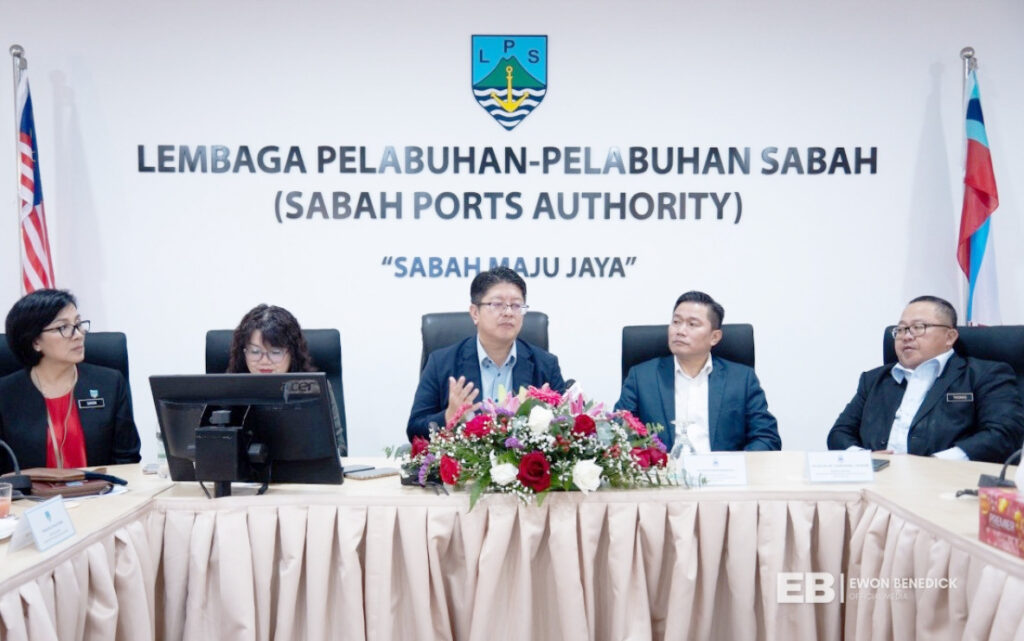
Minister of Industry, Entrepreneurship and Transport, Ewon (centre), chairing a meeting during his official visit to the Sabah Ports Authority here recently.