By WU VUIDE
KOTA KINABALU: A spotted buffalo breed developed by the Sabah Veterinary Services Department (DVS) has strong commercial potential and could attract young people into the livestock industry.
Agriculture, Fisheries and Food Industry Minister Datuk Jamawi Jaafar said the breed is docile, compact, and distinctive, with spotted markings and white eyes.
The breed’s unique characteristics could give it a higher market value than conventional cattle if developed further, he said at DVS Sabah’s 50th anniversary celebration here yesterday.
“Its commercial potential is huge. It is known as spotted cattle and is a local breed,” he said.
Jamawi said the State Government is adopting new approaches to develop the livestock sector, including reactivating grazing reserves in several districts.
The move aims to tackle roaming livestock and improve feed quality by upgrading reserves with new fencing and better grass.
“By upgrading fencing and planting better-quality grass, we can solve the roaming problem and provide farmers with better breeds that have higher meat yields,” he said.
Sabah has about 139 grazing reserves with capacity for about 30,000 head of cattle, but some are unused and damaged fences have allowed livestock to wander onto roads.
The government also plans to replace unproductive, ageing stock with new breeds.
“Past stock has declined in quality by the 10th or 11th generation and is no longer productive. We will replace it.
“When new breeds calve every year, farmers are more motivated to care for them,” he said.
Jamawi and DVS officers recently travelled to Australia to select about 2,800 head of quality livestock, comprising beef cattle, dairy cattle and goats, to meet farmers’ needs.
“We want the industry not only to progress, but to expand,” he said.
He said Sabah’s cattle population has declined over the past 10 years despite annual imports, suggesting shortcomings in existing practices. A new approach will be introduced this year.
Under the revised cattle assistance scheme, a deposit system will replace the previous practice of providing calves or requiring repayment in calves.
“Recipients must place a deposit equivalent to 10 per cent of the market value.
“The deposit will be refunded after three years if the cattle are well cared for. If the animal is neglected or sold within that period, the deposit will be forfeited under prescribed procedures,” he said.
The approach is intended to ensure imported stock continues to produce quality offspring.
“One cow can produce about seven generations, maintaining quality from the selected parent stock,” he said.
On eligibility, Jamawi said one scheme for grazing field users is known as Scheme 50. Applications can be made through district offices and DVS at district level, with priority given to low-income groups (B40) and other target groups to raise incomes.
“Once selected at district level, the stock is developed as parent stock. We provide one breeding cow per recipient,” he said.
Other schemes cover dairy and beef cattle operators, with allocations based on shed size and land area. Dairy farmers operating feedlots must plant feed grass such as Napier grass.
He stressed that knowledge must precede assistance.
“If we give cows or goats to someone with no knowledge, we may end up eating the goats ourselves.
“We provide training. Today, some of our successful farmers have been here from morning till evening. I learn from them,” he said.
He said the presence of successful farmers at the anniversary could show youth that livestock farming is a viable source of income.
DVS provides district-level training on cattle and other livestock rearing, subject to Federal Government allocations.
Sabah also has DVS-reared buffaloes, including in Telupid, as well as quality breeding stock.
Jamawi said he hopes DVS Sabah will continue to grow and provide the best service to livestock farmers statewide.
If livestock provided under the deposit scheme dies of natural causes and the farmer wishes to continue, a replacement can be provided the following year under prescribed procedures, subject to verification.
The livestock development drive aims to increase meat production and quality, grow the agricultural economy and strengthen Sabah’s food security policy.
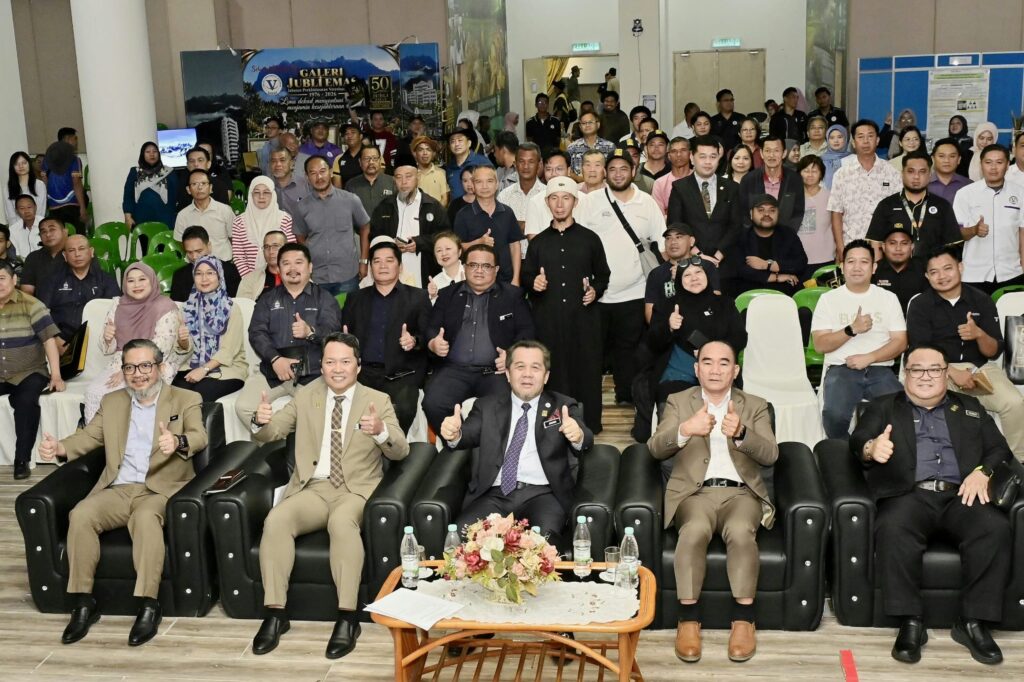
Jamawi (seated, centre), with guests attending the 50th anniversary celebration of DVS.