By WU VUIDE
KUDAT: The conservation efforts in Sabah received recognition from the Malaysia Book of Records (MBR) for planting 12,000 coral fragments on the seafloor within Tun Mustapha Park (TMP) at Simpang Mengayau near Pulau Kalampunian.
The initiative was led by Sabah Parks, along with WWF-Malaysia, Universiti Malaysia Sabah, local communities, enforcement agencies, volunteers, and the private sector.
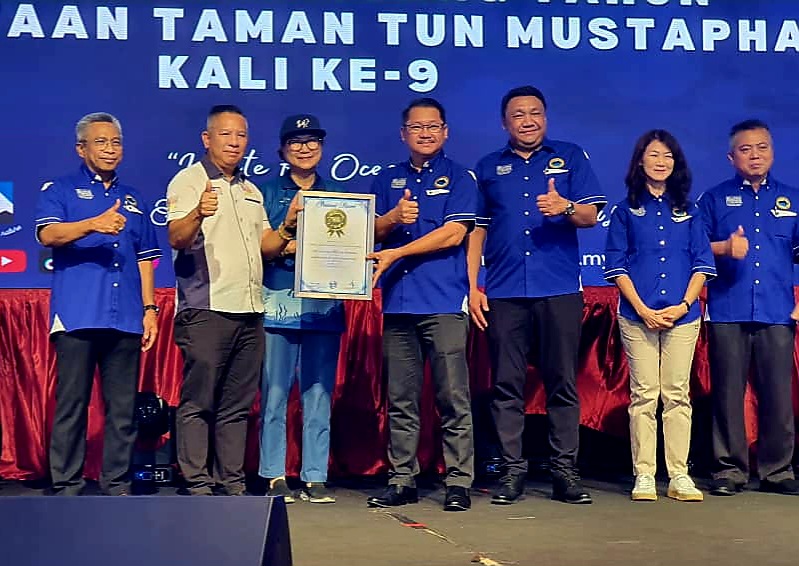
Tourism, Culture and Environment Minister Datuk Seri Christina Liew commended the efforts when officiating the “Malaysia Book of Records – Largest Coral Fragment Planting Event 2025,” held in conjunction with the 9th Anniversary of Tun Mustapha Park’s gazettement, at Dewan Tun Mustapha, Kudat.
Sabah Parks Chairman Peter Lintar received the certificate from MBR official Edwin Yeoh.
The event was themed “Unite for the Ocean – A Shared Commitment to Conserve Marine Ecosystems and Make History.”
She congratulated Sabah Parks Director Dr Maklarin Lakim and his team, as well as all collaborative partners and implementing agencies that turned this vision into reality.
“To the local communities – you are the true guardians of the sea. This collaboration strengthens an inclusive and effective conservation network.
“The figure 12,000 (coral fragments) reflects our determination and unity. This activity was accomplished in just four days with the participation of over 500 individuals.”
The participants comprised certified divers, non-divers, local communities from Kg Tajau Laut and Simpang Mengayau, and various stakeholders, including tourism players.
According to Liew, much of this mammoth project was made possible through corporate social responsibility (CSR) contributions from various entities, including the private sector and non-governmental organisations (NGOs).
She asserted that these contributions reflect broad confidence in marine conservation efforts in Sabah and serve as proof that public-private collaboration can drive sustainable environmental restoration initiatives.
“The spirit of togetherness shown by participants – divers, communities, students, and volunteers – is the true backbone of this event’s success. This is the ‘Unite for the Ocean’ spirit we aim to cultivate,” Liew said.
From another perspective, the Minister noted that this significant project not only contributes to the implementation of biodiversity policies at the state, national, and global levels, but also supports the achievement of Sustainable Development Goals (SDGs), namely SDG 13, 14, and 17 – for climate action, life below water, and partnerships for the goals.
Additionally, she said it reflects Malaysia’s commitment to the Kunming-Montreal Global Biodiversity Framework, especially the “30 by 30” principle.
“My hope is that this initiative does not end as a symbolic event, but is followed through with action plans such as scientific monitoring, community education, and regular reporting so it may serve as a national and global reference,” Liew added.
On the vital role of TMP, the Minister said that since its gazettement nine years ago, TMP has pioneered the management of marine protected areas in Sabah.
Spanning over 898,000 hectares of sea and coastline, it is Malaysia’s largest multi-use marine park and one of the most expansive in the region.
“Today, Tun Mustapha Park is home to over 528 species of fish, 250 species of coral, three endangered sea turtle species, dugongs, dolphins, and iconic species such as whale sharks and whales.
“These achievements result from science-based conservation, including marine biological monitoring and coral restoration techniques, underscoring the importance of scientific data in decision-making and evaluating management effectiveness,” said Liew.
She continued: “Admittedly, preserving such a vast area is no easy task. The decision to gazette TMP was based on years of scientific research, including biodiversity mapping, critical habitat analysis, and data-driven zoning.
“This area encompasses more than 50 islands, including Banggi, Balambangan, Malawali, Tigabu, and Maliangin, with over 80,000 residents living in 53 coastal and island villages.”
This initiative (gazettement) requires unwavering dedication, multi-stakeholder coordination, and patience in facing legal challenges, economic pressures, and climate change, Liew added.
Acknowledging the equally important role played by villages like Tajau Laut, Marang Parang, Bavang Jamal, and the Banggi Island community, she commended them for being key contributors to conservation efforts ranging from joint monitoring and coral reef restoration to community-based ecotourism.
Also present were Tanjong Kapor Assemblyman Datuk Ben Chong, the Ministry’s Permanent Secretary Datuk Josie Lai, and Kudat District Officer Charles William Dabbi.